



DO NOT PUBLISH



Table of Contents
Share with network
Related Insights
Although recent data shows signs of improvement, burnout continues to affect a significant portion of the physician workforce. In a 2025 American Medical Association (AMA) survey, 41.9% of surveyed U.S. physicians reported at least one symptom of burnout, while 31.1% indicated some likelihood of leaving their organization within two years. Physicians also reported an average of 58.4 hours per week on work activities, underscoring the intensity of the current clinical environment.
Behind these numbers are physicians who arrive at work physically and emotionally exhausted, disconnected from their patients and the purpose that drew them to medicine. For health systems and medical groups, burnout affects care continuity, patient experience, workforce stability, productivity, and financial performance. Its causes are equally multifaceted, making one-dimensional solutions insufficient.
Burnout is often viewed as an individual issue, but it can also reflect the strength of an organization's operating model. When physicians lack capacity or disengage, it often points to strain in how the organization is designed and led.
The cost of burnout can appear in direct and indirect ways:
When burnout is treated only as an individual resilience gap, solutions tend to focus on mindfulness, wellness benefits, or short-term relief. While these tools may provide support, they do not address the organizational and leadership factors that contribute to physician strain.
Lasting improvement requires a coordinated strategy that addresses factors at the individual, organizational, and leadership levels.
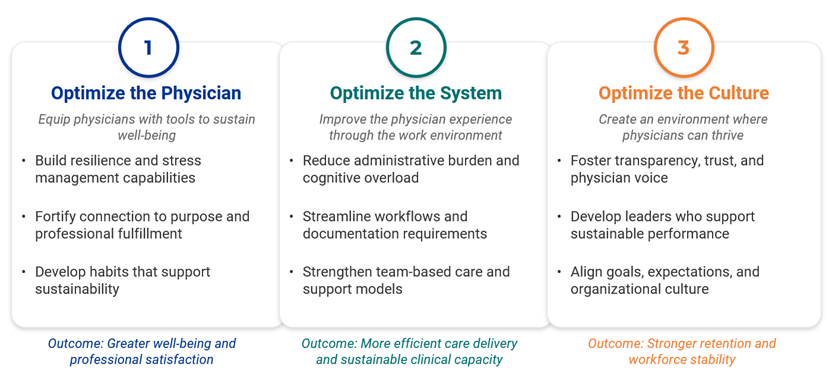
The first focus area helps physicians build the skills and awareness needed to sustain performance and well-being through structured education, coaching, and practical tools focused on:
Many physicians operate in environments marked by documentation demands, decision fatigue, and limited time for deep, uninterrupted work. These daily pressures follow physicians home, weighing on their health, motivation, happiness, and overall quality of life, both personally and professionally.
Combining evidence-based insights with actionable techniques, facilitated discussion, and peer learning helps physicians identify burnout drivers, focus on what they can control, and build sustainable practices that support professional fulfillment, all while earning Continuing Medical Education (CME) credits.
While the first pillar strengthens the individual, many drivers of burnout sit outside any physician's control. The second focus area examines how work is designed, supported, and executed throughout the organization.
Areas of focus include:
In the AMA survey, physicians cited limited control over schedules, inadequate staffing, work-life balance pressures, and lack of leadership support as top stressors. These challenges stem from operational design and not individual performance, which is why lasting improvement depends on changing the environment rather than asking physicians to absorb its demands.
If clinicians are spending too much time on administrative work, if EHR workflows create after-hours burden, or if staffing models depend on constant retraining, well-being interventions alone will not be enough. Reducing burnout requires improving the work itself through initiatives that streamline processes, reduce cognitive burden, and enhance care delivery.
Even a well-supported physician working within a well-designed system can struggle when the surrounding culture undermines trust. The third focus area addresses the leadership behaviors, communication practices, and cultural dynamics that influence the physician experience.
Areas of focus include:
Limited transparency, misalignment around goals and metrics, top-down decision-making, and a lack of physician voice can intensify stress and erode trust. Leaders can strengthen communication and foster healthier workplace dynamics through leadership education, facilitated workshops, executive coaching, and culture-building initiatives.
Culture is one of the strongest buffers against burnout. When leaders communicate openly and engage physicians in decisions that affect their work, physicians are more likely to feel valued and supported. By elevating burnout as a strategic priority, organizations can better connect physician experience with workforce planning, clinical quality, and enterprise performance.
Lasting improvement depends on addressing the individual, operational, and leadership factors behind physician burnout. AMPLOS, powered by Elliott Davis, helps optimize the physician by equipping them with the knowledge and practical tools needed to sustain well-being and performance while earning CME credits. We also work with healthcare organizations to improve systems, strengthen leadership, and foster cultures that create a healthier environment for physicians, care teams, and the patients they serve.
For rural providers and healthcare organizations pursuing workforce development initiatives through the Rural Health Transformation Program, Elliott Davis can align physician well-being and retention strategies with broader workforce priorities. We can also establish the strategy, governance, implementation, and reporting structures needed to advance funded initiatives.
Elliott Davis can further complement that work with services that influence the broader operational and financial environment:
Together, these capabilities support a more holistic approach that treats physician well-being as a strategic priority.
Contact us for a consultation to explore strategies for reducing physician burnout.
The information provided in this communication is of a general nature and should not be considered professional advice. You should not act upon the information provided without obtaining specific professional advice. The information above is subject to change.
the
authors
related
insights
%20(1).jpg)

Explore how the CMS Rural Health Transformation Program impacts rural hospitals, grant governance, and risk management, and why a strong governance model supports long-term viability and overall success.