


DO NOT PUBLISH
Article
November 5, 2026

The finance leader's AI playbook

AI Playbook

Table of Contents

Share with network

Related Insights

Replay: The Finance Leader's AI Playbook: What's Real, Where to Start, and What to Ask

Replay: The Finance Leader's AI Playbook: What's Real, Where to Start, and What to Ask

Lorem ipsum dolor set

The finance leader's AI playbookThe finance leader's AI playbook

The finance leader's AI playbook

Lorem ipsum dolor set

What ESOP sellers need to know about Section 1042 rolloversWhat ESOP sellers need to know about Section 1042 rollovers

What ESOP sellers need to know about Section 1042 rollovers

Lorem ipsum dolor set

Responsible AI starts with governance: Building trust, controls, and accountability into AI adoptionResponsible AI starts with governance: Building trust, controls, and accountability into AI adoption

Responsible AI starts with governance: Building trust, controls, and accountability into AI adoption

Lorem ipsum dolor set

Your next CFO probably isn't looking for a jobYour next CFO probably isn't looking for a job

Your next CFO probably isn't looking for a job

Lorem ipsum dolor set

AI is moving fast, and many finance teams are still working out where it fits.

Manufacturing and distribution finance leaders are asking: How does AI actually work in the month-end close? Where do you start? And what should you ask before you commit? 

In our latest webinar, AI Strategy & Execution Practice Leader Mike Rudinsky and Manufacturing & Distribution Industry Leader Dan Bailey answered those questions by walking through one reconciliation.

Where AI Fits in Finance: The Earned Advantage™ Framework

Earned Advantage™ offers a simple map for adopting AI, with four stages and four kinds of value:

  1. Foundation: Get ready with alignment, safe use, clear rules, and approved tools.
    The value is better judgment and less wasted effort.
  2. Capacity: Put AI to work on everyday tasks, with clear owners.
    The value is hours saved and capacity that can be redeployed.
  3. Leverage: Hand repeatable workflows to agents, with people in charge.
    The value is shorter cycles and consistent results at scale.
  4. Advantage: Build capability competitors can’t buy off the shelf.
    The value is new products, new markets, and strategic differentiation.

Organizations can live in several stages at once. Strategy, governance, people, and systems run through all four. Your AP team might be in one place and FP&A in another.

How an AI Agent Reconciles an Account

In this illustrative example, an agent reconciles prepaid insurance for a sample manufacturer. The agent splits the work between rules and AI. Rules are fixed instructions that handle the data pulls, the math, and every obvious call. AI handles only what the rules can’t: unclear memos, near matches, reading the invoice, and drafting the narrative.

  • Account: 14500 Prepaid Insurance
  • Entity: Plant 07
  • Period: June 2026
  • The Problem: A new $36,000, 18-month policy was paid mid-month but never added to the amortization schedule.

The agent works through the reconciliation in four phases:

  1. Gather the inputs. Rules pull the trial balance (TB), the general ledger (GL) detail, last month’s signed reconciliation, and the amortization schedule. No AI is involved.
  2. Sort and match. Rules label and match what they can. Neither GL line carries a policy ID, which is common in real data, so AI picks up the leftovers. It matches the $10,000 to the existing policy. The $36,000 fits nothing on the schedule, so instead of guessing, AI marks it “needs review.”
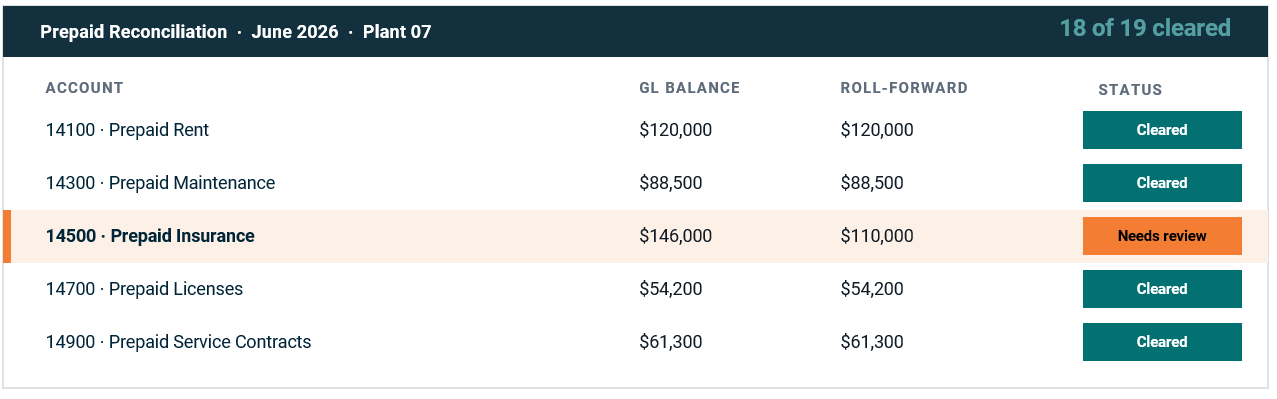
  3. Prove the balance. Rules do the math. The rollforward expects $110,000, the GL shows $146,000, and the $36,000 gap becomes an exception.
  4. Explain and hand off. AI reads the invoice, finds 18 months of coverage starting July 1 at $2,000 a month, cites the document, and drafts the narrative. The agent then packages everything for review.

As Mike put it during the webinar: rules find the problem, and AI tells you what it is.
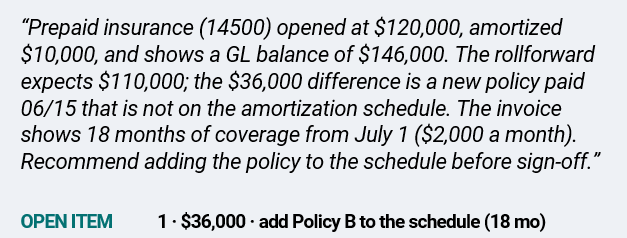
The agent proposes a fix but never posts an entry or changes the schedule. The preparer reviews the evidence, confirms it’s a new policy, and adds it to the schedule. A separate reviewer signs off. The fix lives in the schedule, not in the AI. Nothing is retrained, and in July the account ties on its own at $134,000.

Across every prepaid account at Plant 07, 18 of 19 cleared. Instead of reviewing all 19 line by line, the team focuses on the one that didn’t tie.
This example shows the ideal: an agent running every step, the same way every close. Starting smaller is completely fine. A library of tested prompts that someone on your team runs by hand is a good first step, especially for one-off analysis, a new process, or rules that are still changing. Once a process holds up for a few month-end closes, it makes sense to move it into an agent-run workflow.

Every AI Step Is Followed by an Independent Check

If AI mislabels a transaction, the tie-out catches it. If it matches a payment to the wrong policy, the schedule check catches it. If it misreads an invoice, the reviewer catches it before sign-off.

Agent controls include:

  • Rules define every exception. AI investigates but never decides what gets flagged.
  • TB must equal GL before anything runs. That’s the completeness check auditors already test.
  • Every step is logged, whether it was a rule or AI: what it saw and what it cited.
  • Prompt and rule changes are approved, just like any control change: versioned, tested, and signed off.
  • The preparer resolves exceptions, and a separate reviewer signs off. The agent never posts entries, preserving segregation of duties.

What You Do with the Time Is the Advantage

With a faster close and fewer late adjustments, that extra time can go toward:

  • Reviewing margin by product, including freight, rebates, and returns
  • Explaining cost variances by plant weekly
  • Modeling material and freight changes before quotes go out
  • Running a weekly cash forecast
  • Bringing a new plant’s books onto your close faster
  • Absorbing growth without adding staff
  • Keeping good people longer

Ask yourself: Which decisions are you making on last month’s numbers that you’d rather make on this week’s?

One caution from the webinar: write down your team’s judgment before you redeploy the time. The exceptions are where your team’s expertise lives, and the documented rules are what make the agent work. If that expertise walks out the door first, the agent gets weaker.

How to Evaluate AI Use Cases and Vendors Before You Commit

As part of Earned Advantage, each AI use case is scored from 1 to 5 on three questions:

  1. Value: Is it worth doing?
  2. Readiness: Can we get it done?
  3. Risk: What if it’s wrong?

Value and readiness decide where a use case lands on your list. Risk decides how much control the agent gets. If you bring in a vendor to deliver them, ask:

  • How does it show its reasoning on each item?
  • Who owns the control, and how is it tested?
  • What happens when the model changes?
  • Can we cap what it does on its own?
  • If we leave, what do we keep?

If a vendor can’t answer these clearly, that tells you a lot about whether it’s ready for your month-end close. Vendor review should also tie into your own AI governance program: policies, ownership, risk tiers, and oversight have to come from your organization.

We Can Help

Whether you’re just getting started, automating a few workflows, building agents to run the work, or turning the time you get back into an edge, Elliott Davis can help you take the next step. 

Contact our AI Strategy & Execution team to get started.

The information provided in this communication is of a general nature and should not be considered professional advice. You should not act upon the information provided without obtaining specific professional advice. The information above is subject to change.

the

authors

contact our team

contact our team

contact our team.