

DO NOT PUBLISH



Table of Contents
Share with network
Related Insights
Artificial Intelligence (AI) is transforming how organizations evaluate information, identify risks, automate workflows, and support business decisions. When implemented effectively, AI can enhance operational efficiency, strengthen decision-making, and improve business performance.
However, AI does not create business value simply because it is adopted. Sustainable value is realized when AI can be trusted. Trust in AI is built through governance, oversight, and controls that help organizations identify AI use cases, understand how AI influences business processes and decisions, validate AI-generated outputs, and maintain clear accountability for outcomes.
Governance should not be viewed as a barrier to innovation. Rather, it provides the structure needed to enable responsible adoption, build confidence in AI-enabled decisions, and realize the full value of AI across the organization.
Organizations often want to move quickly into AI-enabled workflows, automation, and efficiency gains. However, sustainable value is achieved by establishing the right foundation before scaling adoption. The Elliott Davis AI Value Path outlines four stages of AI maturity: Foundation, Capacity, Leverage, and Advantage.
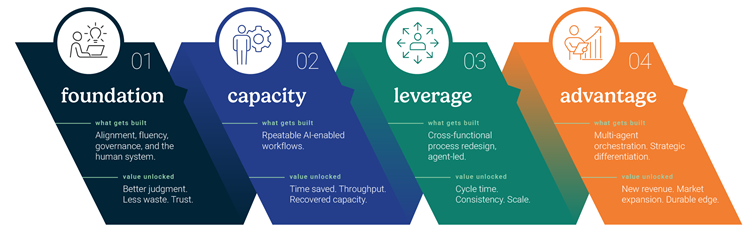
Each stage builds upon the last. Organizations that establish shared intent, AI fluency, governance, and accountability early are better positioned to scale AI-enabled workflows, transform business processes, and ultimately achieve sustainable competitive advantage.
The sequence is important. Many organizations rush to capture quick wins through automation before establishing the governance, oversight, and controls needed to support AI at scale, often limiting their ability to realize long-term value from their AI investments.
Governance strengthens trust and creates the foundation for sustainable AI adoption. As organizations increase their use of AI, governance must mature alongside it:
AI introduces new considerations across five key risk domains in the organization:
To identify potential gaps, organizations should ask:
Difficulty answering these questions may indicate unmapped risk stemming from unclear ownership, weak monitoring, insufficient documentation, poor data controls, or limited visibility into AI use.
Business leaders are asking: “How do we manage AI responsibly?”
Governance provides the transparency, accountability, and oversight needed to support responsible AI adoption and use. It helps organizations define ownership, manage risk, validate outcomes, and maintain compliance so AI can be deployed with confidence and scaled sustainably.
A strong framework includes:
These capabilities remain important throughout The AI Value Path, but the emphasis shifts as organizations mature.

At the Foundation stage, the focus is on establishing strategy, policies, ownership, and responsible experimentation.
During the Capacity stage, organizations place greater emphasis on validation, monitoring, and controls that support scalable, repeatable use.
As organizations reach Leverage, governance extends beyond individual use cases and into end-to-end business processes. Ownership, accountability, and process-level controls become increasingly important.
At the Advantage stage, governance operates as an enterprise capability. Continuous monitoring, performance management, drift detection, compliance oversight, and audit readiness help sustain trust while enabling AI to support critical business decisions at scale.
This progression of governance advances alongside AI maturity to provide the structure and confidence organizations need to scale AI adoption successfully.
AI scales insights and decisions faster than traditional governance and oversight processes were designed to support.
Controls operationalize governance by applying safeguards across the AI lifecycle:
The key takeaway is that controls are not intended to slow AI adoption. They provide assurance that AI is operating as intended and help build the trust needed to rely on AI-generated insights in decision-making.
Organizations do not need to solve every AI governance challenge at once. Start by asking:
The next step depends on where the organization is on The AI Value Path.
Elliott Davis helps organizations establish practical AI governance and control solutions that drive value. Our multidisciplinary teams identify AI risk, define accountability, assess controls, and develop governance approaches aligned with business objectives, risk profiles, and strategic priorities.
Whether you are exploring AI, deploying AI-enabled workflows, or enhancing an existing program, effective governance, controls, and oversight help organizations scale adoption successfully.
Interested in learning more about AI Governance? Watch the replay of our AI Governance Webinar to explore practical strategies for governing AI, managing emerging risks, and implementing controls that enable responsible and sustainable adoption.
Contact us today to start the conversation.
The information provided in this communication is of a general nature and should not be considered professional advice. You should not act upon the information provided without obtaining specific professional advice. The information above is subject to change.
related
insights