.jpg)





DO NOT PUBLISH




Table of Contents
Share with network
Related Insights
Most construction business owners begin thinking about value when a sale is on the horizon. By then, however, many of the factors that influence valuation have already been established through years of decisions around strategy, operations, financial management, workforce development and customer relationships.
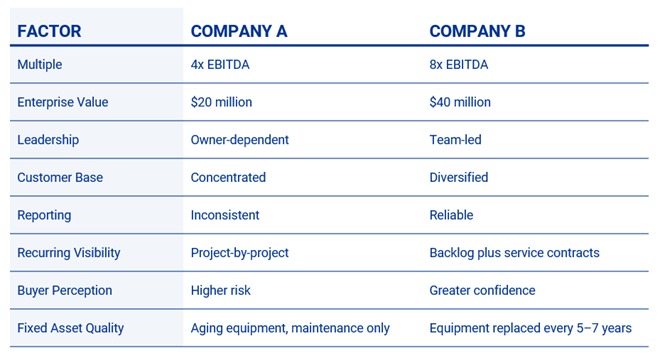
Enterprise value matters whether your goal is a sale, succession plan, employee stock ownership plan (ESOP), acquisition strategy, capital raise, talent retention, or long-term independence. The intentional application of these strategies drives enterprise value creation. In today’s market, the difference between a business valued at four times EBITDA and one valued at eight times EBITDA often comes down to one question: How predictable, scalable, and transferable is the business?
(EBITDA = Earnings Before Interest, Taxes, Depreciation, and Amortization)
Construction remains highly attractive to strategic buyers and private equity investors. Demand for infrastructure, power, utilities, advanced manufacturing, healthcare, and data centers continues to fuel investment. At the same time, labor shortages, succession challenges, and industry fragmentation are driving consolidation opportunities and stronger transition outcomes for owners who prepare before going to market.
While EBITDA remains important, buyers also place significant emphasis on risk, earnings quality, transferability, and future performance. They evaluate factors such as:
Revenue Quality
Transferability
Operations & Risk
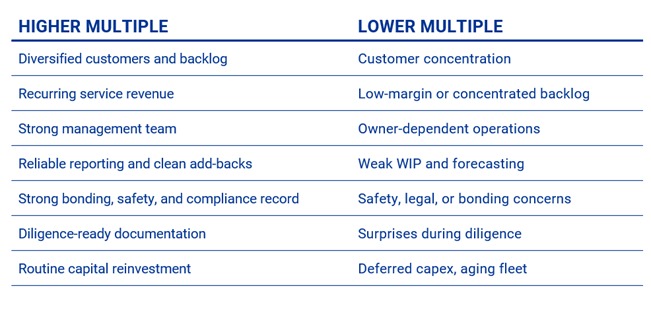
Assume two contractors each generate $5 million of EBITDA. Company A receives a 4x multiple, while Company B receives an 8x multiple because buyers perceive materially different risk, growth, and transferability profiles.
A large backlog is valuable only if it supports profitable, predictable growth. Buyers increasingly evaluate backlog composition, including contract terms, margins, customer relationships, project duration, and end-market exposure. Contractors with diversified customers, strong demand drivers, and recurring revenue sources often demonstrate greater earnings stability and lower risk.
Ongoing service and maintenance contracts, inspection services, and repeat customer relationships provide earnings stability that project-based revenue may not. To strengthen enterprise value, contractors should focus on:
Contractors serving high-demand sectors such as data centers, power and utilities, advanced manufacturing, healthcare, and infrastructure often present a stronger long-term growth story.
Strong bonding capacity can further enhance value by expanding project opportunities and demonstrating financial stability. Ultimately, buyers want evidence that growth can continue after a transition through scalable operations, diversified revenue, and strong profitability.
In construction, workforce capacity has become a strategic advantage. Skilled labor shortages have increased demand for experienced field personnel, project managers, estimators, and superintendents. Buyers often view a stable workforce as an asset that is difficult to replicate.
Strong organizations demonstrate:
Leadership depth is equally important. One of the most common diligence concerns is owner dependence. Buyers look for organizations that can sustain operations, customer relationships, and strategic direction without relying on the founder for every key decision.
Companies with strong management teams and documented standardized operating procedures (SOPs) coupled with robust succession plans are often viewed as lower-risk, more transferable investments.
Construction businesses live and die by execution. Buyers want evidence that project performance can be measured, managed, and forecasted consistently.
Key areas of focus include:
Profit fade, margin erosion, inconsistent reporting, and weak project controls frequently create valuation pressure during diligence.
Many owners underestimate the level of scrutiny involved in a transaction. Buyers review financial performance, tax compliance, technology, safety, legal matters, insurance, labor, bonding, and environmental risk. As discussed in A Seller’s Guide to Integrated Diligence, organizations that prepare across financial, tax, and technology workstreams before going to market can identify risks earlier, reduce surprises, and enter negotiations from a stronger position.
Several issues that consistently attract buyer attention include:
Financial & Transaction Readiness
Leadership & Workforce Stability
Operational & Business Risk
If you want maximum value in 2–3 years, start building the business today as if a buyer were evaluating it tomorrow.
Create the operational and financial discipline buyers expect.
Key priorities:
Milestone: Reliable reporting, stronger controls, and less owner dependency.
Tax planning note: Evaluate potential S corporation to C corporation conversion strategies early.
Focus on making the business more attractive, scalable, and attractive to buyers.
Key priorities:
Milestone: Stronger growth potential, lower risk, and greater buyer appeal.
Validate the value created and prepare for a smooth transaction or succession.
Key priorities:
Milestone: A transaction-ready business positioned to enhance value and reduce surprises.
The highest-value construction companies are built years before a transaction through disciplined execution, strategic planning, workforce investment, and operational excellence.
As outlined in Is Your Business Ready to Sell?, owners who prepare early create more options, greater leverage, and stronger outcomes. Whether your objective is growth, succession, acquisition, ESOP ownership, or an eventual sale, the actions you take today will affect your company’s future potential and optionality.
Enterprise value reflects how well your business can perform, grow, and succeed independent of its current ownership. The earlier you focus on those fundamentals, the more opportunities you create.
Contact Elliott Davis to prepare your business for growth, transition, or sale.
The information provided in this communication is of a general nature and should not be considered professional advice. You should not act upon the information provided without obtaining specific professional advice. The information above is subject to change.
related
insights