


Table of Contents
Share with network
Related Insights
Annual budget season often begins with a familiar routine: gather last year’s results, update assumptions, collect department input, and finalize next year’s plan.
For many middle-market companies, it is also an opportunity to evaluate whether the finance function is equipped to support growth.
As companies expand, enter new markets, or prepare for investment, leadership needs a planning system that explains performance, forecasts future outcomes, and supports better decision-making.
Most companies do not outgrow budgeting all at once. The warning signs usually appear gradually:
The issue is not that the budget is broken. More often, leadership is relying on a process designed for an earlier stage of growth.
Budgeting should become part of a broader planning framework that connects strategy, operations, and financial outcomes.
Modern Financial Planning & Analysis (FP&A) is an ongoing process that connects reporting, forecasting, scenario modeling, and strategic decision-making.
FP&A helps leadership:
Finance functions advance through five stages of maturity.
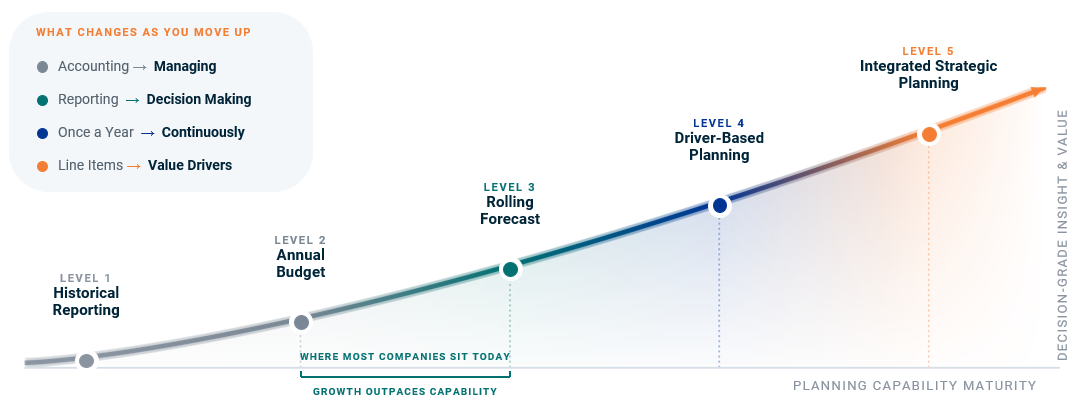
Most companies today sit at Level 2 or 3, where growth begins to outpace existing finance capabilities. At this point, historical reporting and static budgets are no longer enough.
One of the most important signs of financial maturity is moving from line-item budgeting to value driver-based planning.
Rather than assuming revenue will increase by a fixed percentage, leadership identifies the operational factors that influence results, such as:
The specific drivers vary by industry. Healthcare organizations may focus on patient volume and reimbursement rates, distributors on shipment volume and inventory turns, and manufacturers on throughput, labor efficiency, and capacity utilization.
By linking financial performance to operational drivers, organizations gain clearer forecasting, decision-making, and conversations with boards, lenders, and investors.
A budget reflects a point in time. FP&A builds on that foundation by creating a continuous planning process that links business strategy to financial outcomes.
Leaders define objectives, identify the drivers that influence performance, translate them into operating plans, forecast outcomes, and adjust as conditions change.
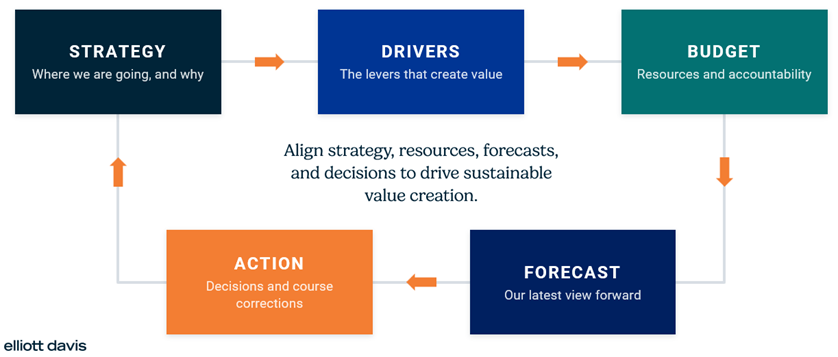
Instead of waiting until year-end to reset expectations, leadership can:
Rolling forecasts strengthen this process by helping leaders evaluate a range of possible outcomes early enough to act. Long-range planning extends the horizon, connecting strategic initiatives to a multi-year financial roadmap.
For private equity-backed companies, long-range planning also provides a framework for executing the value creation plan, translating growth, margin improvement, working capital, and operational initiatives into measurable outcomes and enterprise value.
Organizations may need to evaluate:
Without a long-term view, leadership may approve strategic initiatives without fully understanding the financial path required to execute them.
A mature planning process depends on reliable data, efficient systems, and clear processes. When finance teams spend budget season compiling spreadsheets, chasing inputs, reconciling data, and rebuilding reports manually, less time is available for analysis and decision support.
Effective FP&A supports every stage of the planning framework, from measuring performance drivers and managing budgets to forecasting outcomes and informing action. These environments often include:
These tools do not replace judgment. They provide leadership with faster access to better information.
The benefits include:
Most organizations can advance planning maturity incrementally, beginning with reliable reporting and a single source of truth before building forecasting, scenario analysis, and long-range planning capabilities.
Many companies recognize that their budgeting process is becoming more difficult, but struggle to identify where the gaps exist or what to improve first.
Elliott Davis helps organizations assess their planning maturity and build the FP&A capabilities needed to support growth. Our modular approach allows customers to strengthen individual planning components or implement a more comprehensive planning framework.
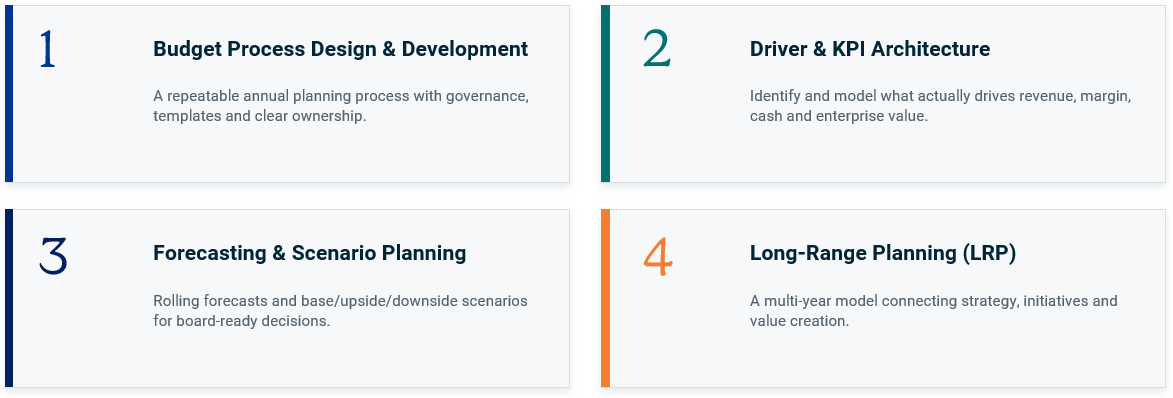
The result is less time spent managing data and spreadsheets and more time generating insights that improve performance and create enterprise value.
Ready to evaluate your planning maturity? Contact Elliott Davis to build FP&A capabilities that support the next stage of your business.
The information provided in this communication is of a general nature and should not be considered professional advice. You should not act upon the information provided without obtaining specific professional advice. The information above is subject to change.
the
authors
related
insights


Discover how private equity fund managers can prepare for audits at the fund level. Learn key differences between SBIC and non-SBIC structures, common pitfalls, and six practical steps to ensure compliance and protect investor confidence.

Discover how healthcare CFOs can harness AI to drive operational efficiency, reduce burnout, and improve patient outcomes. Learn scalable strategies for financial performance, workforce support, and compliance in U.S. healthcare systems.

Discover how California’s finalized market-based sourcing rules will reshape asset management taxation in 2026. Learn what CFOs and fund managers must do now to prepare for investor-based fee sourcing and expanded compliance obligations.