

Table of Contents
Share with network
Related Insights
While loan-level data is fundamental to internal and external financial reporting, specialty finance companies also rely on it to support underwriting, servicing, credit loss models, and fair value measurements. When data is inaccurate, incomplete, or not properly monitored, the consequences extend beyond operational inefficiencies to misstated financial reporting, distorted valuations, and flawed management decisions.
The challenge intensifies in high-volume lending environments where data flows across multiple systems and third-party service providers. Each system handoff, data transfer, or manual adjustment introduces risk. Even small errors, when repeated across thousands of loans, can accumulate into material issues.
This article outlines where data quality and third-party control breakdowns most often occur in high-volume lending organizations and highlights practical steps companies can take to strengthen oversight and reduce audit risk.
Specialty finance companies often manage thousands of small‑balance loans across automated underwriting systems, separate origination and servicing platforms, and multiple reporting environments. Loan‑level data frequently feeds directly into current expected credit loss (CECL) models, fair value measurements, and internal reporting, often through data warehouses or spreadsheets.
Since CECL and fair value models rely heavily on this data, auditors examine data lineage from source systems to model inputs, including controls over extraction, transformation, and validation of key fields. This becomes even more complex for acquired portfolios subject to updated CECL guidance, such as the gross‑up requirements introduced under ASU 2025‑08.
In these environments, small mistakes can multiply quickly, affecting:
In high‑volume lending environments, audit risk tends to concentrate at a few recurring points in the data lifecycle. Since small issues can create downstream reporting and valuation challenges, these are the areas auditors examine most closely:
Loan boarding is one of the most common sources of downstream issues. Audit questions often include:
Errors at this stage affect every downstream process, from income recognition to credit modeling.
In high-volume environments, system interfaces are frequent audit focus areas. Auditors look for evidence that:
The expectation extends beyond confirming jobs run to validating the results.
Since CECL and fair value models rely heavily on loan-level data, auditors examine:
Model outputs are only as reliable as the data supporting them.
Manual activity introduces additional risk, particularly in spreadsheet-based environments. Common audit questions include:
Without clear review and documentation, manual adjustments are difficult to defend during audit.
To maintain control in high-volume lending environments, specialty finance companies often benefit from:
These steps help turn data quality from an informal practice into a controlled, repeatable process that supports reliable reporting, valuations, and business decisions.
Many specialty finance companies rely on third-party providers for servicing, collections, loan platforms, hosting, and data storage. While these arrangements support scale, they introduce additional financial reporting and control risks. Outsourcing does not transfer responsibility. Management remains accountable for data accuracy and reporting outcomes.
Auditors assess whether third‑party reliance is supported by effective oversight and controls across several areas:
Auditors ask:
SOC reports support reliance but do not replace internal controls.
Auditors expect evidence that management actively monitors third-party servicers, including:
Passive reliance is a common audit finding.
When third-party data feeds CECL models, fair value calculations, or interest income reporting, auditors look for:
Summary reports alone are rarely sufficient.
Frequent issues include:
These gaps often surface during growth, acquisitions, or system changes.
Loan portfolio valuations and audit conclusions depend on the integrity of the data flowing through origination, servicing, and reporting systems. While a point‑of‑sale (POS) system is typically covered by a SOC report, that coverage rarely extends to every downstream system used for aggregation, modeling, and financial reporting.
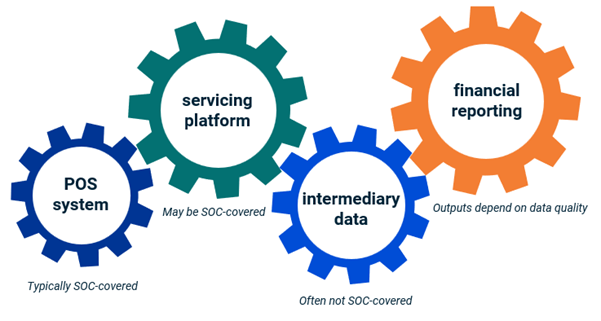
When data moves from a SOC‑covered system into intermediary platforms, data warehouses, or reporting tools, internal controls must be applied at each step. These intermediary environments often feed significant accounting estimates and disclosures, making them a frequent audit focus.
Common valuation risks include:
As specialty finance portfolios grow in size and complexity, investors and capital providers increasingly scrutinize how companies govern data and oversee third parties. Effective controls across both internal systems and outsourced providers support complete and accurate information, defensible valuations, smoother audits, and greater confidence in reported results.
To strengthen oversight and reduce audit friction, companies can:
In high-volume specialty lending environments, data quality and third-party oversight are foundational to reliable financial reporting. Companies that invest in disciplined data governance and structured monitoring of outsourced activities reduce audit risk, improve transparency, and enhance investor confidence.
Elliott Davis supports specialty finance companies through:
Contact us today to get started.
The information provided in this communication is of a general nature and should not be considered professional advice. You should not act upon the information provided without obtaining specific professional advice. The information above is subject to change.
related
insights