
DO NOT PUBLISH




Table of Contents
Share with network
Related Insights
The One Big Beautiful Bill Act (OBBBA) brings new rules for meals and entertainment deductions beginning in tax years after December 31, 2025. While the categories haven’t changed much, the deductibility rules have. For business owners, this means far fewer employer provided meals will qualify. Only a limited set of specific situations will still allow a deduction under the new law.
Below is a table summarizing the changes:
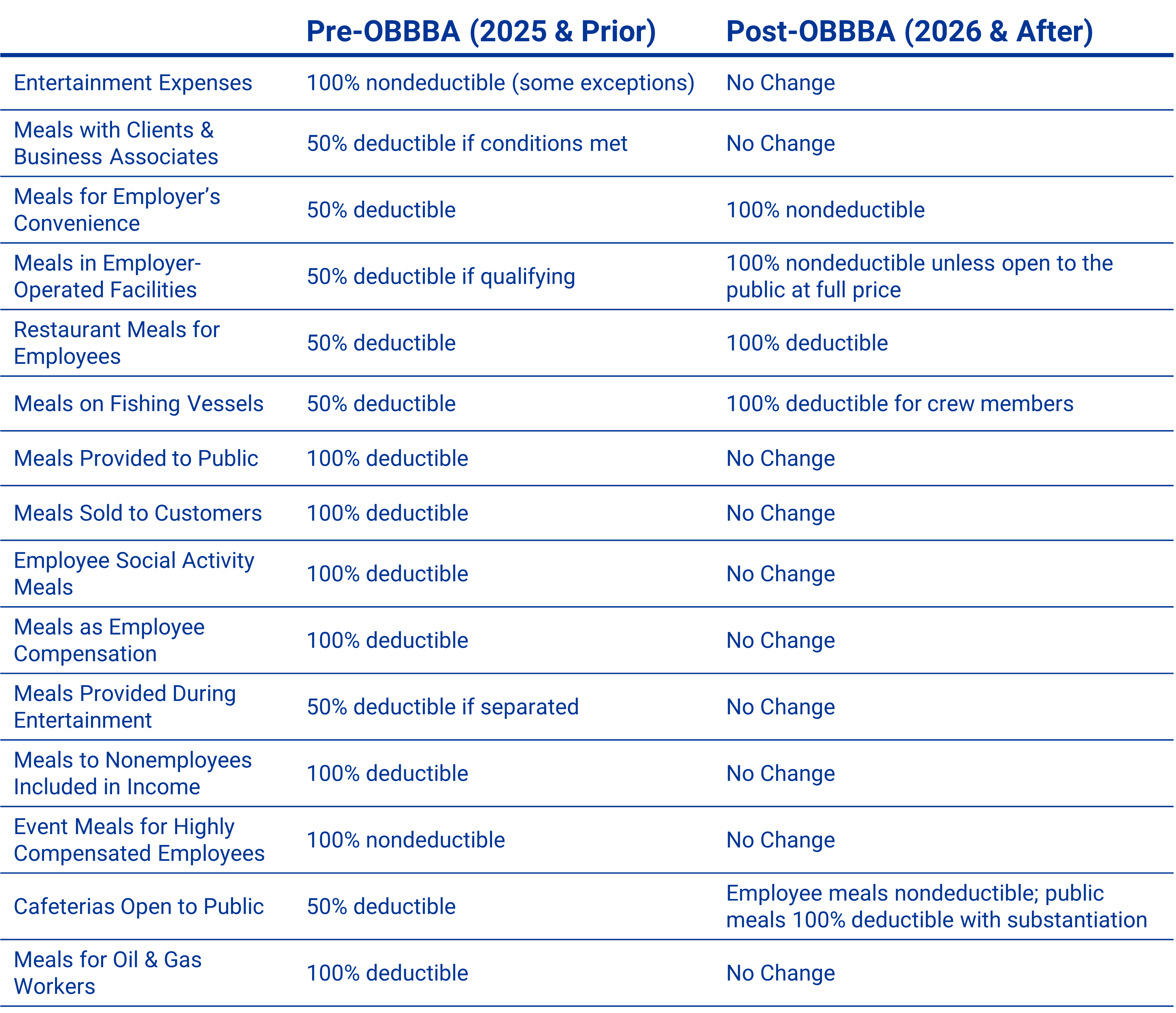
Since the OBBBA significantly limits the deductibility of employer-provided meals, most businesses will need to make some operational and accounting adjustments. As you prepare for the 2026 tax year, consider the following:
The Elliott Davis team helps business owners adapt to the new tax requirements and the strategic decisions that follow. We can assist with policy updates, recordkeeping, and planning so you’re well prepared for the 2026 tax year. Contact us to discuss how these changes may affect your business and what steps to take next.
The information provided in this communication is of a general nature and should not be considered professional advice. You should not act upon the information provided without obtaining specific professional advice. The information above is subject to change.
the
authors
related
insights

Helping a manufacturer identify over $1.2M in job credits
Learn how the Elliott Davis State and Local Tax (SALT) team helped a boat manufacturer relocating to South Carolina uncover $400K in tax credits and secure a $215K refund. Discover how expert tax incentive analysis can maximize savings and future benefits.

Strategic decision-making supported through modeling
Discover how Elliott Davis's cash flow modeling helped a manufacturing business gain insight into future cash balances, optimize capital investment decisions, and benchmark performance. Learn how strategic financial planning enhances reporting and decision-making.

Why organizations should implement a GRC management tool
Discover how Governance, Risk, and Compliance (GRC) tools enhance efficiency, security, and visibility in managing IT and business risks. Learn how automated workflows and real-time reporting can streamline compliance and improve organizational resilience.
Pass-through entity tax elections
Learn how pass-through entity (PTE) tax elections can help business owners bypass the federal SALT deduction cap. Explore state-specific rules, potential tax savings, and key considerations to determine if this election is right for your business.

What is a penetration test and how is automated different than manual?
Understand the differences between automated and manual penetration testing to strengthen your cybersecurity. Learn how expert-led testing mimics real-world cyber threats, uncovers critical vulnerabilities, and enhances your security posture.