



DO NOT PUBLISH




Table of Contents
Share with network
Related Insights
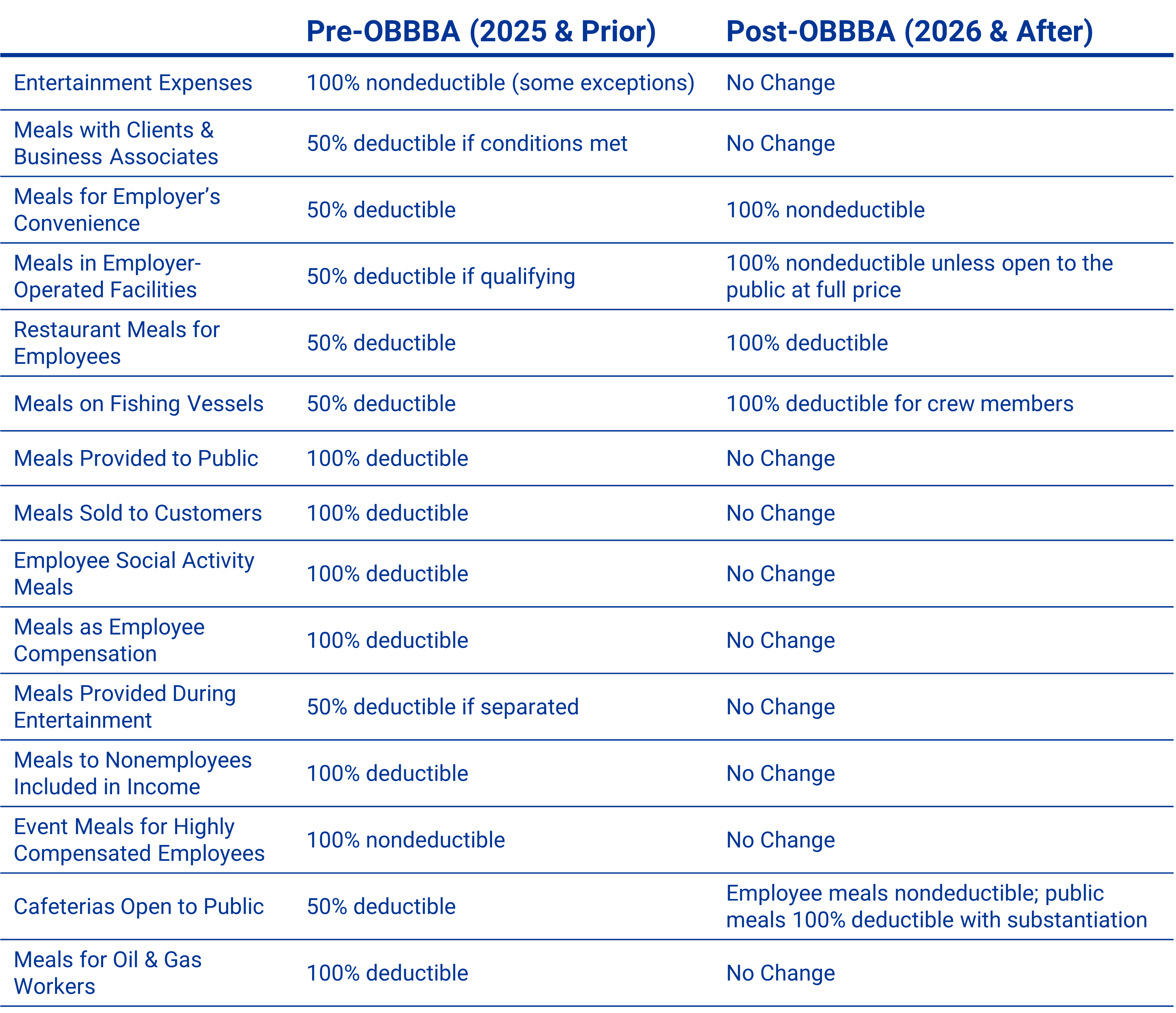
The One Big Beautiful Bill Act (OBBBA) brings new rules for meals and entertainment deductions beginning in tax years after December 31, 2025. While the categories haven’t changed much, the deductibility rules have. For business owners, this means far fewer employer provided meals will qualify. Only a limited set of specific situations will still allow a deduction under the new law.
Below is a table summarizing the changes:
Since the OBBBA significantly limits the deductibility of employer-provided meals, most businesses will need to make some operational and accounting adjustments. As you prepare for the 2026 tax year, consider the following:
The Elliott Davis team helps business owners adapt to the new tax requirements and the strategic decisions that follow. We can assist with policy updates, recordkeeping, and planning so you’re well prepared for the 2026 tax year. Contact us to discuss how these changes may affect your business and what steps to take next.
The information provided in this communication is of a general nature and should not be considered professional advice. You should not act upon the information provided without obtaining specific professional advice. The information above is subject to change.
the
authors
related
insights


Federal Financial Institutions Examination Council announces two significant changes
The FFIEC has updated its IT examination guidelines, expanding the Development, Acquisition, and Maintenance (DA&M) booklet and retiring the Cybersecurity Assessment Tool (CAT) by August 31, 2025. Financial institutions must now enhance IT risk management and adopt alternative cybersecurity frameworks like NIST 2.0 and CISA Cybersecurity Performance Goals to stay compliant.

Tax Alert – Tax relief for Section 1031 exchanges in the aftermath of Hurricane Helene
The IRS has extended tax deadlines to May 1, 2025, for individuals and businesses in areas affected by Hurricane Helene, including Alabama, Georgia, North Carolina, South Carolina, and parts of Florida, Tennessee, and Virginia. This relief provides significant benefits for real estate investors completing Section 1031 exchanges, offering extended deadlines for identifying and purchasing replacement properties.

Port strike strains supply chain
A tentative agreement between the International Longshoremen's Association (ILA) and the US Maritime Alliance (USMX) ended a two-day strike, averting a potential $5 billion economic impact. While supply chain disruptions were minimal, this event underscores the importance of proactive risk management, inventory buffers, and diversified logistics strategies to mitigate future disruptions.