
find your solution.
search for solutions by category, industries, insights, and people.

DO NOT PUBLISH
search for solutions by category, industries, insights, and people.



Table of Contents
Share with network
Related Insights
Strong loan performance can create confidence, but it can also reduce the scrutiny that keeps credit practices sound. Over time, small accommodations, such as an override supported by prior payment history, a renewal completed with stale financials, or a covenant waiver approved without deeper review, can reset what teams accept as normal.
This pattern, known as complacency creep, can weaken credit discipline long before delinquencies or charge-offs show the damage. Effective credit risk management for financial institutions requires leaders to examine how decisions are made, how exceptions are governed, and whether current borrower information supports repayment capacity.
Complacency creep is a decline in underwriting, monitoring, and escalation practices during periods of favorable performance. Policies, approval authorities, and risk ratings may remain unchanged even as execution begins to drift from established controls.

Common examples include:
The risk appears when similar decisions accumulate across lenders, products, channels, or borrower groups in financial services. What looks immaterial in one file can become a material portfolio pattern.
As of the second quarter of 2026, U.S. bank industry aggregates showed noncurrent loans at 0.93% of loans, nonperforming assets at 0.57% of total assets, and net charge-offs at 0.57% of average loans. These figures describe reported outcomes. They do not measure weakening documentation, layered exceptions, stale borrower information, or delayed risk-rating changes. (Source: S&P Capital IQ, U.S. Banking Industry Aggregates, Q2 2026.)
Years of low rates supported refinancing and may have embedded liberal underwriting in portfolios. Subsequent rate increases and the 2023 bank failures changed funding, liquidity, and borrower economics without producing a uniform credit correction. As a result, risk may be building within portfolios before it appears in traditional loss metrics.
Current payment performance can create a similar blind spot. A borrower making scheduled payments today may still have declining liquidity, tighter cash flow, rising leverage, or an industry exposure that warrants added attention. Credit risk analysis should pair performance data with current borrower information, repayment capacity, and portfolio risk indicators.
In retail and residential portfolios, risk may build through higher override rates, longer terms, rising debt-to-income ratios, inconsistent documentation, or rapid growth. Since these portfolios contain many smaller credits, leaders should analyze trends instead of treating each exception in isolation. Fewer exceptions are preferable, but severity and layering matter as much as volume.
Commercial portfolios require a different lens. Fewer large relationships can create concentrated exposure to borrower-specific events. Warning signs include outdated financial statements, frequent covenant waivers, unchanged risk ratings despite weaker conditions, and increased dependence on collateral or guarantors. Analysis should test cash flow, debt service capacity, liquidity, industry conditions, and downside assumptions.
Start by testing how policies are applied in individual credits, then look across the sample for patterns management may not be seeing.
These patterns can provide an earlier indication of weakening credit discipline before deterioration shows up through delinquencies, downgrades, or losses.
Financial institutions can begin with a focused plan that connects credit discipline, portfolio monitoring, independent review, and governance support to specific evidence and deadlines:
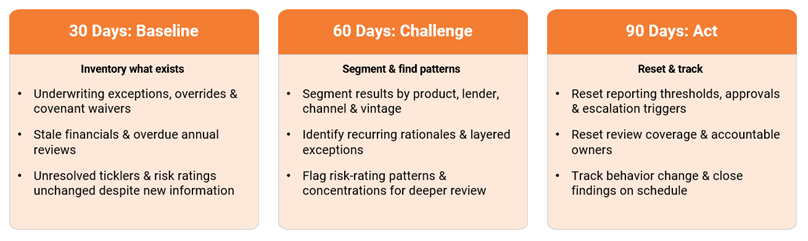
Elliott Davis helps financial institutions assess whether credit controls are well designed, consistently executed, and capable of identifying emerging risk early. Our professionals provide credit risk assessment, internal audit, and governance support tailored to portfolio structure, growth, concentrations, and existing oversight processes.
We can evaluate underwriting and renewal practices, analyze exception trends, test monitoring and risk ratings, review committee and board reporting, and help management establish accountable corrective actions.
Contact us for a focused assessment to show where complacency creep is taking hold and lay out a plan to reinforce credit discipline before reported performance deteriorates.
The information provided in this communication is of a general nature and should not be considered professional advice. You should not act upon the information provided without obtaining specific professional advice. The information above is subject to change.
the
authors
related
insights


Microsoft® Power BI™ best practices: Lessons learned - reports and deployment
Struggling with data modeling and reporting in Power BI? Discover nine expert best practices for designing, deploying, and sharing reports effectively. From optimizing visuals to leveraging deployment pipelines and Power BI Apps, this guide will help you build a data-driven culture with powerful insights.

Microsoft® Power BI™ best practices: Lessons learned - data engineering and Data Analysis Expressions (DAX)
Struggling with data engineering and DAX in Power BI? Learn eight best practices to optimize transformations, improve query performance, and enhance calculations. Boost your data modeling skills and efficiency with expert insights.

Microsoft® Power BI™ best practices: Data modeling and sources
Struggling with data modeling in Power BI? Our certified analysts share eight best practices to optimize data sources, improve performance, and build a data-driven culture. Learn how to streamline ETL processes, enhance query efficiency, and maximize insights with Power BI.