find your solution.
search for solutions by category, industries, insights, and people.

search for solutions by category, industries, insights, and people.
search for solutions by category, industries, insights, and people.


The Centers for Medicare & Medicaid Services (CMS) Rural Health Transformation (RHT) Program is one of the most significant federal–state healthcare funding initiatives in decades. Authorized under the One Big Beautiful Bill Act, the program commits $50 billion over five years (FY2026–FY2030) to support new approaches to improving access, sustainability, and outcomes in rural healthcare.
Once a state releases its Notice of Funding Opportunity (NOFO), organizations often have a short window, sometimes as little as six weeks, to assemble partnerships, design projects, and submit applications.
The organizations best positioned to benefit are those that treat RHT not as a grant-chasing exercise, but as a five-year transformation effort that requires planning well before funding announcements are released.
The RHT Program is federally authorized and implemented by states, making it distinct from traditional Medicare or Medicaid funding models and signaling a possible evolution in how public healthcare gaps are addressed.
This structure allows RHT to pick up where Medicare and Medicaid leave off, enabling states to direct funding toward access challenges that existing programs do not fully address. Rural communities often face fewer providers, longer travel distances, and limited care options. With roughly 20% of the U.S. population living in rural areas, RHT focuses on workforce investment, technology adoption, care delivery redesign, and regional collaboration to close persistent access gaps.
RHT funding also reflects broader federal fiscal dynamics. Reductions in federal healthcare spending have increased pressure on states to deploy RHT dollars thoughtfully and defensibly. As a result, the program is not only a near-term funding vehicle, but a policy experiment that may inform how future federal–state healthcare initiatives supplement core entitlement programs.
Although RHT is federally authorized, it is designed and implemented at the state level. Each state develops its own priorities, funding structures, and application processes.
For rural hospitals and healthcare providers, this means strategy must account for:
Successful applicants position their proposals as part of the broader transformation agenda the state is advancing.
It’s also important to recognize that funding is not required to flow directly to rural providers, and there is no single national playbook governing how funds are awarded. As a result, success depends on understanding state intent and translating those priorities into well-aligned, defensible proposals.
States that have already released RHT guidance or early NOFOs provide important clues about how funding decisions are likely to be made.
Across early adopters, several themes are emerging:
Organizations that wait for the NOFO often underestimate the internal control, compliance, and reporting infrastructure required to responsibly manage RHT funding.
Many state RHT requests for proposals are expected to open April–June, often with 45–60 day submission windows. Once a NOFO is released, organizations may have only weeks to:
That timeline limits strategic decision-making. Some choices simply cannot be made well in six weeks, particularly those involving multi-year operating models and workforce capacity.
RHT funding is time-limited. Strategic planning should extend beyond award and implementation to how programs will be funded after grant dollars expire. Organizations should evaluate whether new services generate ongoing revenue or measurable cost savings, and how workforce and technology investments fit within long term operating models.
Treating RHT as a multi-year transformation arc, rather than a one-time funding opportunity, helps reduce the risk of post grant instability.
Before applying, organizations should have clarity on:
Internal alignment accelerates decision-making once state guidance is released. Without it, even strong opportunities stall. Failure to align projects with how states ultimately measure success may also expose providers to funding reductions or clawbacks.
RHT funding can materially change the financial profile of an initiative and how it should be prioritized. Ultimately, strategic decisions come down to how an organization allocates its time and money. When those resources are misallocated, the consequences can be significant.
For example, consider a project that initially ranked low as an organizational priority because it delivered a 10% internal rate of return (IRR). If that same project receives RHT funding over five years, even after accounting for added compliance costs, its projected IRR could increase to 25%, elevating it to a top-tier priority. See the illustrative example below.
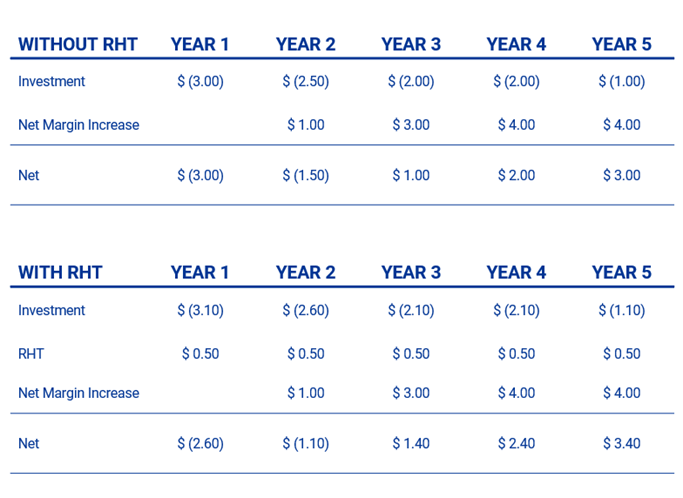
This reframes prioritization decisions as lower-priority initiatives may become financially compelling, and “shovel-ready” projects can take on new urgency. For the leadership team, RHT should alter how initiatives are evaluated, not simply which grants are pursued.
RHT compliance requirements are often underestimated. Each grant carries its own reporting cadence, performance metrics, and repayment provisions for noncompliance. If required data is incomplete or reported outcomes fail to meet defined thresholds, grant funds may be subject to repayment, even if services have been delivered.
In many cases, organizations face structural gaps that heighten the risk:
For multi-state healthcare systems participating in hundreds of state-specific grant programs, these challenges compound quickly, increasing exposure and straining already limited administrative capacity. Underestimating the compliance costs will overstate expected ROI and could result in poor allocations of capital that put the organization at risk and strain finances.
Early engagement can influence outcomes when approached with intention. A proactive strategy may include participation in regional collaboratives, state-level outreach to understand priorities, and early conversations with potential partners.
Elliott Davis works with rural healthcare providers across the full RHT lifecycle, including:
We help organizations decide which opportunities to pursue, prepare to respond quickly, and support the operational discipline required to retain funding and deliver lasting value.
Contact us to start the conversation.
The information provided in this communication is of a general nature and should not be considered professional advice. You should not act upon the information provided without obtaining specific professional advice. The information above is subject to change.





%20(1).jpg)