Every industry has its own nuances. We take that into consideration and approach business solutions with the specific lens required of your field. Our teams are comprised of talent with relevant experience and we’re prepared to meet every challenge.
What do you actually do with AI? In the final episode of this three-part series, Dr. Drew Brannon and Michael Wolinsky move from reflection to action, exploring how individuals and organizations can begin using AI effectively.
CMS Rural Health Transformation Program: Early lessons about compliance, capacity, and implementation
Early Rural Health Transformation Program (RHTP) recipients are learning that compliance, capacity, and implementation demands begin the moment an award is won.
The Hidden Cost of Task Switching
Ever finish a meeting and struggle to focus on the task in front of you?
What a growth mindset in construction can do: Building future leaders and stronger companies
Learn how a growth mindset helps construction companies develop future leaders, strengthen culture, improve retention, and increase long-term business value.
AI Strategy Starts with People (Part 2)
AI adoption isn't as simple as choosing a tool and training your team to use it.
Every industry has its own nuances. We take that into consideration and approach business solutions with the specific lens required of your field. Our teams are comprised of talent with relevant experience and we’re prepared to meet every challenge.
What do you actually do with AI? In the final episode of this three-part series, Dr. Drew Brannon and Michael Wolinsky move from reflection to action, exploring how individuals and organizations can begin using AI effectively.
CMS Rural Health Transformation Program: Early lessons about compliance, capacity, and implementation
Early Rural Health Transformation Program (RHTP) recipients are learning that compliance, capacity, and implementation demands begin the moment an award is won.
The Hidden Cost of Task Switching
Ever finish a meeting and struggle to focus on the task in front of you?
What a growth mindset in construction can do: Building future leaders and stronger companies
Learn how a growth mindset helps construction companies develop future leaders, strengthen culture, improve retention, and increase long-term business value.
CMS Rural Health Transformation Program: Early lessons about compliance, capacity, and implementation
Lorem ipsum dolor set
How a healthcare organization scaled IT leadership through Office of the CIO services
Lorem ipsum dolor set
SEC semiannual reporting proposal: What financial institution leaders need to know
Lorem ipsum dolor set
Should community banks reconsider the Community Bank Leverage Ratio?
Lorem ipsum dolor set
Your next CFO probably isn't looking for a job
Lorem ipsum dolor set
Diving into the world of Artificial Intelligence (AI) can sometimes feel like deciphering a bowl of alphabet soup—AI, ML, RPA, and so on. AI has rapidly evolved from a niche academic field to a cornerstone of modern technology. This article will break down the key terms, provide a brief history of AI, and explore its technological evolution to help you understand how we got here and what it means for the future.
Decoding the Jargon
Let’s start with the basics:
Artificial Intelligence (AI): AI is the umbrella term for machines designed to mimic human brainpower—learning, reasoning, and correcting themselves along the way. Imagine having a super-smart assistant who gets better at their job the more they work. AI encompasses a broad range of technologies and applications, from chatbots to self-driving cars.
Machine Learning (ML): A star pupil under the AI umbrella, ML is all about algorithms learning from data to make predictions. If AI is the assistant, ML is the diligent intern who learns and adapts to improve performance. ML is used in various applications, from recommendation systems like Netflix® and Amazon® to fraud detection in banking.
Robotic Process Automation (RPA): The taskmaster of the tech world, automating the mundane tasks we all dread. Imagine having a robotic helper for those repetitive, soul-crushing tasks, freeing you up to focus on more strategic work. RPA is widely used in industries like finance, healthcare, and customer service to automate routine processes.
Generative AI: The creative genius of the AI family, generative AI creates new content from existing data. Tools like ChatGPT and DALL-E are prime examples, producing everything from poetry to realistic images. This technology is revolutionizing content creation, from automated news articles to creating new art forms.
A Brief Walk-Through AI History
To appreciate where we are today, let's take a stroll down memory lane:
1950s: The AI journey kicks off with Alan Turing’s provocative question, “Can machines think?” leading to the famous Turing Test. Turing's work laid the foundation for what we now understand as AI, proposing that if a machine could converse indistinguishably from a human, it could be considered intelligent.
1960s: The term "artificial intelligence" debuted at Dartmouth in 1956*, which led to wider attention of AI in the 1960’s. Researchers like John McCarthy and Marvin Minsky created early AI projects, developing basic algorithms and exploring the potential of machine learning.
1980s: Enter expert systems, AI’s first commercially successful application, proving that AI isn’t just academic. These systems showed that AI could help solve real-world problems, even if they weren’t quite as flashy as HAL 9000 from "2001: A Space Odyssey." Expert systems were used in industries like medical diagnosis and financial services, demonstrating the practical benefits of AI.
2000s: The digital age turbocharges AI with data and computing power, setting the stage for major breakthroughs. Advances in hardware, particularly the advent of powerful GPUs, enabled the development of more complex AI models. This period saw the rise of big data, providing the vast datasets needed to train machine learning algorithms.
2010s and beyond: AI goes from geek to chic, becoming integral in everything from your smartphone to self-driving cars. The development of deep learning, a subset of machine learning, has driven much of the recent progress in AI. Technologies like neural networks have enabled breakthroughs in image and speech recognition, natural language processing, and more.
Technological Evolution
The path from theoretical AI to practical applications has been anything but linear. Today, AI helps doctors diagnose diseases with uncanny accuracy and lets businesses predict customer behavior with precision. It's not just about smarter machines; it's about augmenting human capabilities and transforming industries. True utilization of AI and its capabilities is in equipping people within the business to focus on what they do best: thinking creatively, providing pertinent solutions, and leading their teams well. Companies are leveraging AI to optimize supply chains, personalize marketing efforts, and enhance customer experiences. The potential applications are vast, ranging from autonomous vehicles to smart homes and beyond.
The Present and Future of AI
As we look to the future, AI's potential continues to expand. Innovations in quantum computing could further accelerate AI development, enabling even more complex computations and algorithms. Additionally, ethical considerations and the need for robust AI governance are becoming increasingly important. Ensuring AI systems are transparent, fair, and accountable will be crucial as they become more embedded in our daily lives. The integration of AI into various sectors presents both opportunities and challenges, requiring thoughtful regulation and oversight.
Conclusion
Understanding AI, its history, and its technological evolution is crucial as we navigate the future. AI is not just a buzzword; it represents a significant shift in how we live and work. By grasping the basics, appreciating the history, and anticipating future developments, we can better prepare for the changes and opportunities that AI brings. As we continue to integrate AI into various aspects of our lives, it is essential to do so thoughtfully and ethically, ensuring that the benefits are widely shared and the potential risks are mitigated.
Want More Information? Suggested reads by our author include:
"AI: A Very Short Introduction" by Margaret A. Boden – A concise exploration of AI's past, present, and potential.
Stanford University's "AI and Life in 2030" – Envisions AI's influence on urban life a decade from now.
MIT Technology Review: A collection of articles tracing AI's milestones and mishaps.
The information provided in this communication is of a general nature and should not be considered professional advice. You should not act upon the information provided without obtaining specific professional advice. The information above is subject to change.
Surviving the Great Freight Recession: Credit, capacity, and the road ahead
The U.S. trucking industry faces a prolonged downturn. Explore credit access, fleet capacity, and survival strategies for lenders and operators in this Elliott Davis deep dive.
November 10, 2025
Better together: How finance and operations are a winning team
Discover how strategic alignment between Finance and Operations drives smarter decisions, agile execution, and sustainable growth, especially for healthcare providers navigating cost and performance challenges.
November 4, 2025
Tax Thursday in Three: October 30, 2025
Elliott Davis provides quick updates on 2025 tax news
Video
October 30, 2025
How a tech company recovered $1.2 million in state tax refunds
Discover how a California-based tech company recovered $1.2 million in state refunds by correcting income apportionment errors. Learn how expert SALT guidance uncovered overlooked savings and helped the business understand their state tax position.

Case Study
October 15, 2025
New, enhanced QSBS tax benefits: What small business owners and investors need to know
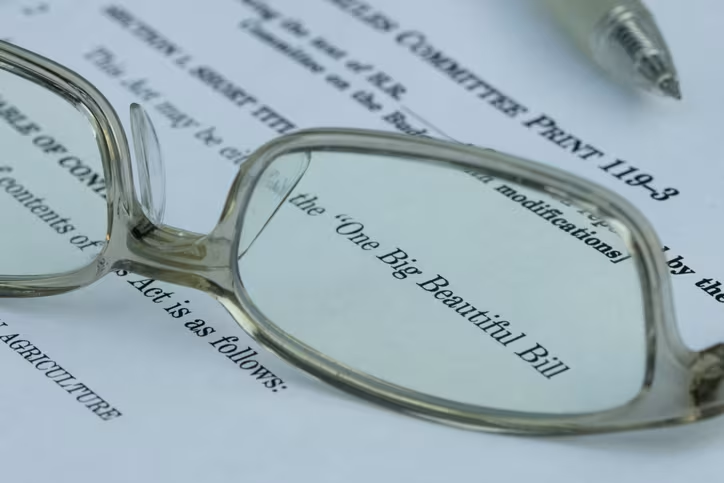
Stay informed on how the recent changes to Qualified Small Business Stock (QSBS) under IRC 1202 affect tax strategy, exit planning, and investment structure for founders, investors, and growing companies. Learn how the One Big Beautiful Bill Act expands gain exclusions and raises asset thresholds.
Article
October 14, 2025
Tax Thursday in Three: October 9, 2025
Elliott Davis provides quick updates on 2025 tax news in October