DO NOT PUBLISH
Article
November 18, 2026

AI controls for financial institutions: What internal audit should be asking now

Table of Contents

Share with network

Related Insights

Is strong credit performance hiding risk? How financial institutions can stop complacency creepIs strong credit performance hiding risk? How financial institutions can stop complacency creep

Is strong credit performance hiding risk? How financial institutions can stop complacency creep

read insight
AI controls for financial institutions: What internal audit should be asking nowAI controls for financial institutions: What internal audit should be asking now

AI controls for financial institutions: What internal audit should be asking now

read insight
2026 BSA/AML/CFT trends: Emerging money laundering risks for financial institutions2026 BSA/AML/CFT trends: Emerging money laundering risks for financial institutions

2026 BSA/AML/CFT trends: Emerging money laundering risks for financial institutions

read insight
FSG Quarterly Financial Services Update - Q3 2026

FSG Quarterly Financial Services Update - Q3 2026

read insight
Replay: Financial Services Group Quarterly Accounting and Reporting UpdateReplay: Financial Services Group Quarterly Accounting and Reporting Update

Replay: Financial Services Group Quarterly Accounting and Reporting Update

read insight

Executive Summary

  • AI may already be operating across financial institutions through employee tools, existing software, and third-party platforms.
  • Existing governance, access, change management, data, and vendor controls remain the foundation for managing AI risk.
  • Controls should reflect each AI use case’s impact, automation, data sensitivity, and human oversight.
  • Financial institutions remain accountable for AI provided through vendors and other third parties.
  • Internal audit should assess AI inventories, controls, monitoring, accountability, and emerging risks as adoption expands.

How Should Financial Institutions Approach AI Controls?

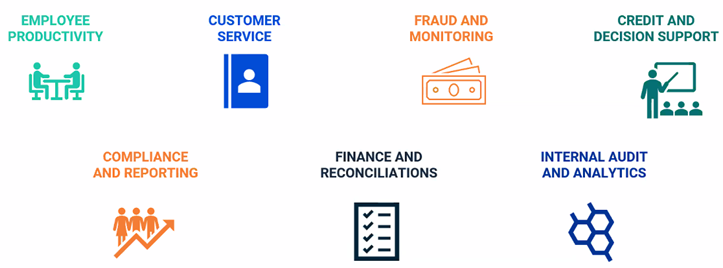
AI is already entering financial institutions through employee productivity tools, customer service platforms, fraud monitoring, credit analysis, compliance, financial reporting, and internal audit. In some cases, institutions may be using AI without formally implementing an “AI system” because AI capabilities are embedded within existing software or introduced through vendor updates.

Do existing controls still work when AI becomes part of the process? In many cases, the answer is yes, but their application may need to change. Governance, access, change management, operations, third-party management, and data management remain the foundation. Internal audit should identify where AI is being used, understand the impact, and determine whether the controls are appropriate for the risk.
Where Is AI Already Being Used?

The first step is identifying where and how AI is used across the institution. Some applications are easy to identify, while others may enter a third party or employee use.

An AI inventory should identify approved tools, embedded features, vendor-provided services, and informal staff use. For each material use case, institutions should document its purpose, data involved, degree of automation, people or processes affected, and accountable owner

Internal audit should determine whether it is reasonably complete, trace use cases to appropriate approvals and controls, and confirm that responsibility is clearly assigned.

How Does AI Change the Risk Profile?

AI introduces new risk patterns, but familiar control principles still apply.

  • Transparency: An institution may have difficulty explaining or reproducing an AI-assisted decision if it does not retain relevant inputs, prompts, model versions, and outputs. Employees or customers may also be unaware that AI contributed to an outcome.
  • Reliability: AI-generated answers can appear authoritative while being incomplete, unsupported, or incorrect. Responses may also vary when users submit similar requests, making traditional testing methods less effective.
  • Technology change: Models, vendor features, configurations, and connected data sources can change quickly. AI performance can also degrade over time, while vendors may add AI capabilities to existing products outside the institution’s standard implementation process.
  • Human behavior: A polished AI response can encourage employees to accept the output without sufficient review. Informal use may also bypass security, privacy, procurement, or records-management controls.

Which AI Controls Matter Most?

Existing IT and risk management controls provide a useful foundation for AI governance, including accountability, access, change management, operational monitoring, vendor oversight, and data protection. The question is whether those controls still address the specific risks created by each use case.

Controls should reflect potential impact. Drafting an internal document presents a different risk than AI influencing lending, fraud detection, customer communications, financial reporting, or movement of funds. As AI progresses from assisting an employee to recommending or executing an action, stronger controls may be appropriate.

Relevant factors include the sensitivity of the data, financial or regulatory impact, degree of automation, human review, and the ability to identify and reverse an error.

What Does an Effective AI Control Lifecycle Look Like?

Controls should continue throughout the AI lifecycle.

  1. Data: Before approving a new use case, document its purpose, owner, acceptable use, data requirements, potential impact, and required controls. Determine whether sensitive, confidential, customer, or regulated information is involved.
  2. Approval: Define which tools and uses are permitted. Address access rights, data connections, retention settings, administrative permissions, and restrictions on entering protected information into unapproved tools.
  3. Validation: Evaluate accuracy, security, reliability, and performance before significant use. Testing should include common scenarios, known edge cases, and inappropriate-use scenarios relevant to the institution and intended application.
  4. Human review: Require qualified employees to evaluate significant outputs before they influence consequential decisions. Review expectations should specify what employees need to verify, when escalation is required, and who has authority to intervene.
  5. Monitoring: Track performance, errors, overrides, complaints, incidents, and unexpected outcomes. Reassess controls when models, vendors, data, configurations, or related business processes change.

Who Is Accountable for Third-Party AI?

Using an external AI service does not transfer responsibility for customer, operational, compliance, or reporting outcomes. Institutions should understand where data is processed and retained, whether prompts or outputs may train vendor models, which providers and subcontractors support the service, and how material changes are communicated.

Contracts and operating procedures should also address security, privacy, confidentiality, data ownership, incident notification, audit rights, service monitoring, and contingency planning. Internal audit should confirm that vendor risk reviews address the AI capability itself rather than assessing only the broader software product.

Questions to Ask Your Team

  • Do we know where AI is being used and who owns each significant use case?
  • Are acceptable uses defined, with sensitive and customer information protected?
  • Are significant AI outputs independently reviewed and key decisions explainable?
  • Are vendor, model, and configuration changes monitored, along with errors and unintended outcomes?
  • Does the internal audit plan reflect the institution’s most significant AI risks?

We Can Help

Internal audit can address AI through existing audits of lending, fraud, customer service, financial reporting, human resources, compliance, cybersecurity, and third-party risk, prioritizing AI uses with potential consequences for customers, regulatory obligations, the accuracy of financial statements, information security, material operations, or the movement of funds.

At Elliott Davis, our Digital Risk Services team can help financial institutions assess AI use, identify control gaps, evaluate governance and third-party risk, and incorporate AI considerations into existing internal audit and technology risk programs.

Contact us to discuss your institution’s AI governance, controls, and internal audit priorities.

The information provided in this communication is of a general nature and should not be considered professional advice. You should not act upon the information provided without obtaining specific professional advice. The information above is subject to change.

the

authors

contact our team

contact our team

contact our team.