

Table of Contents
Share with network
Related Insights
Many construction firms report that their current Enterprise Resource Planning (ERP) system lacks the automation or integration they need to scale. If your ERP system once fit like a glove, but now feels more like a straitjacket, it may be time to reassess.
As construction firms expand, their needs naturally grow in kind. What worked for a $15 million contractor with 30 employees may now hinder a $50 million firm managing multiple job sites, service lines, and compliance demands. In this new stage, upgrading your ERP doesn’t have to mean scrapping what you have and starting from scratch. By identifying where your people, processes, and technology are misaligned, you can adjust accordingly to optimize your existing ERP systems to meet your needs.
Rightsizing starts with a question: Can your current system support where you’re headed?
For some firms, the answer is yes, but only with the right integrations, training, and process tweaks. For others, a targeted replacement (like swapping out finance modules while keeping a best-in-class project management tool) is the smarter move. The key is to assess honestly, then act decisively. Below, we illustrate three different scenarios with real-world examples.
A regional custom home builder with over two decades of experience had grown significantly, taking on more complex and higher-volume projects. However, their systems hadn’t kept pace. Reporting was slow, spend monitoring was reactive, and finance teams were buried in spreadsheets.
Instead of starting over, the builder invested in professionalizing their accounting and finance infrastructure. They reached out to Elliott Davis to conduct a full current-state vs. future-state analysis, identifying which ERP features could be optimized, and which needed replacing. A detailed roadmap helped align tools, users, and reporting needs, leading to more automation, fewer errors, faster project reporting, and better decision-making for leadership.
An engineering firm operating in both commercial and residential sectors was on track to triple in size. Their ERP system was technically capable, but poor implementation left them with siloed workflows, manual month-end entries, inconsistent project costing, and limited access to useable data.
This client needed help to:
This was a case where the client didn’t need a new system, only better alignment between tools, teams, and reporting.
Some firms do reach a tipping point where their systems need a complete replacement. One fast-growing home service provider, generating $15 million in revenue, had outgrown QuickBooks and their entry-level accounting support. As their client base became more sophisticated, they sought a construction-focused solution that could scale with their business. They turned to us to implement an ERP ecosystem that better reflected their capabilities.
We guided them through the selection and implementation of a new ERP ecosystem, focusing on:
Our roadmap prioritized high-impact areas for immediate improvement. After the new program went live, we provided ongoing support for system stability and user adoption.
Recent disruptions, from supply chain volatility to labor shortages, have exposed the limitations of disconnected systems. ERP systems help contractors:
Today’s customers and bonding agents expect near-instant access to job health and cost status.
Curious how your ERP can become a strategic command center for your business? Read our related insight.
When tailored and integrated correctly, ERP centralizes and enhances these key construction functions:
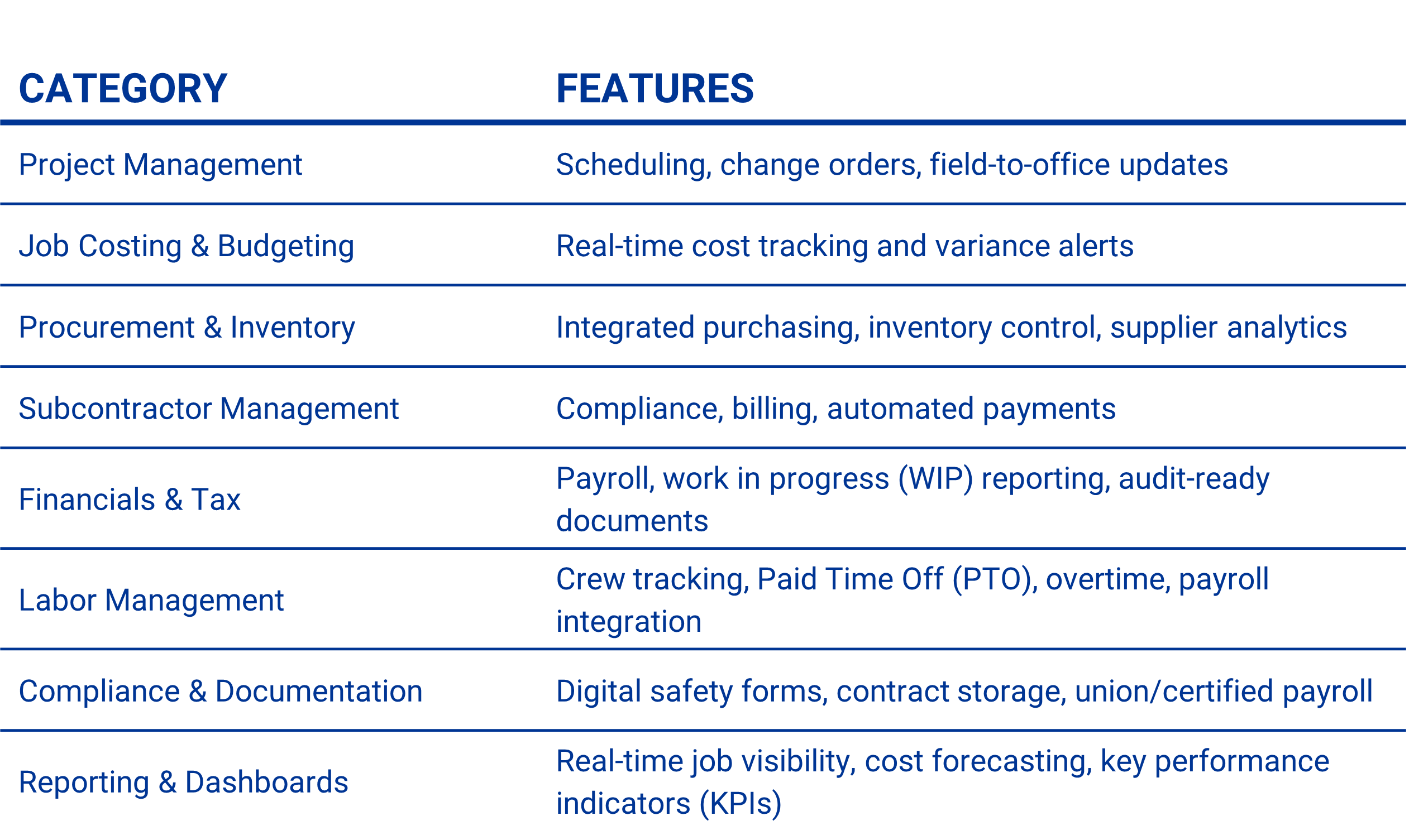
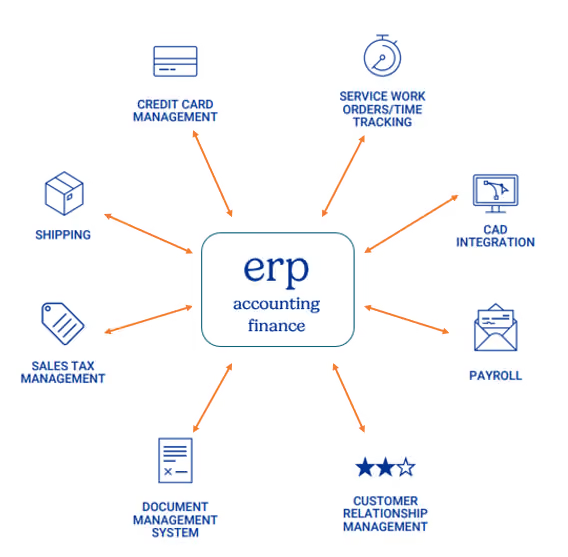
Having accurate, up-to-the-minute information in one system enables construction teams to quickly adjust to demand fluctuations, market volatility, and planning requirements.
Top firms are transforming project management from reactive to proactive by fully leveraging their ERP systems to:
Even the most advanced ERP can become a burden without the right implementation strategy.
At Elliott Davis, we help construction contractors make the most of their ERP strategy, whether that means optimizing existing systems, improving adoption, or mapping a path to something new.
We offer:
Ready to modernize your ERP? Let’s talk about the smartest way to scale your construction business.
Contact us today to start the conversation.
The information provided in this communication is of a general nature and should not be considered professional advice. You should not act upon the information provided without obtaining specific professional advice. The information above is subject to change.
the
authors
related
insights









.jpg)