

DO NOT PUBLISH



Table of Contents
Share with network
Related Insights
In business, stagnation rarely announces itself. It creeps in through familiar processes and aging dashboards. The same accounting system that once seemed efficient now slows reconciliations, obscures data, and limits visibility from the top. Without vigilance, growth can outpace the tools that were originally designed to measure it.
For many companies, upgrading financial platforms feels expensive and disruptive. Yet the longer leaders postpone the decision, the higher the hidden costs climb, measured in lost time, unreliable data, and decisions made in the dark. These shortcomings can undermine compliance, scalability, and profitability.
Every system carries an expiration date. While it may not stink like old milk, the hazards of using a platform beyond its original capabilities are best detected early and avoided. The risk is not contained to a single dramatic failure but rather a gradual erosion of efficiency and trust as compliance gaps may widen, manual errors can multiply, and opportunities for automation slip away.
Many leaders ask: Do we really need a new system? While the better question is: What’s the cost of not having one?
Delaying the decision to upgrade technology often results in:
These costs compound over time, making proactive investment far less expensive than reactive fixes.
The symptoms aren’t hard to spot, though they often fade into the background of daily operations. If any of these sound familiar, your accounting software may be holding you back:
Each symptom represents a moment when the investment stops serving the strategy and begins constraining it.
Choosing the right platform depends on your company’s stage of maturity. See the chart below for an overview of three popular platforms and the business needs they best
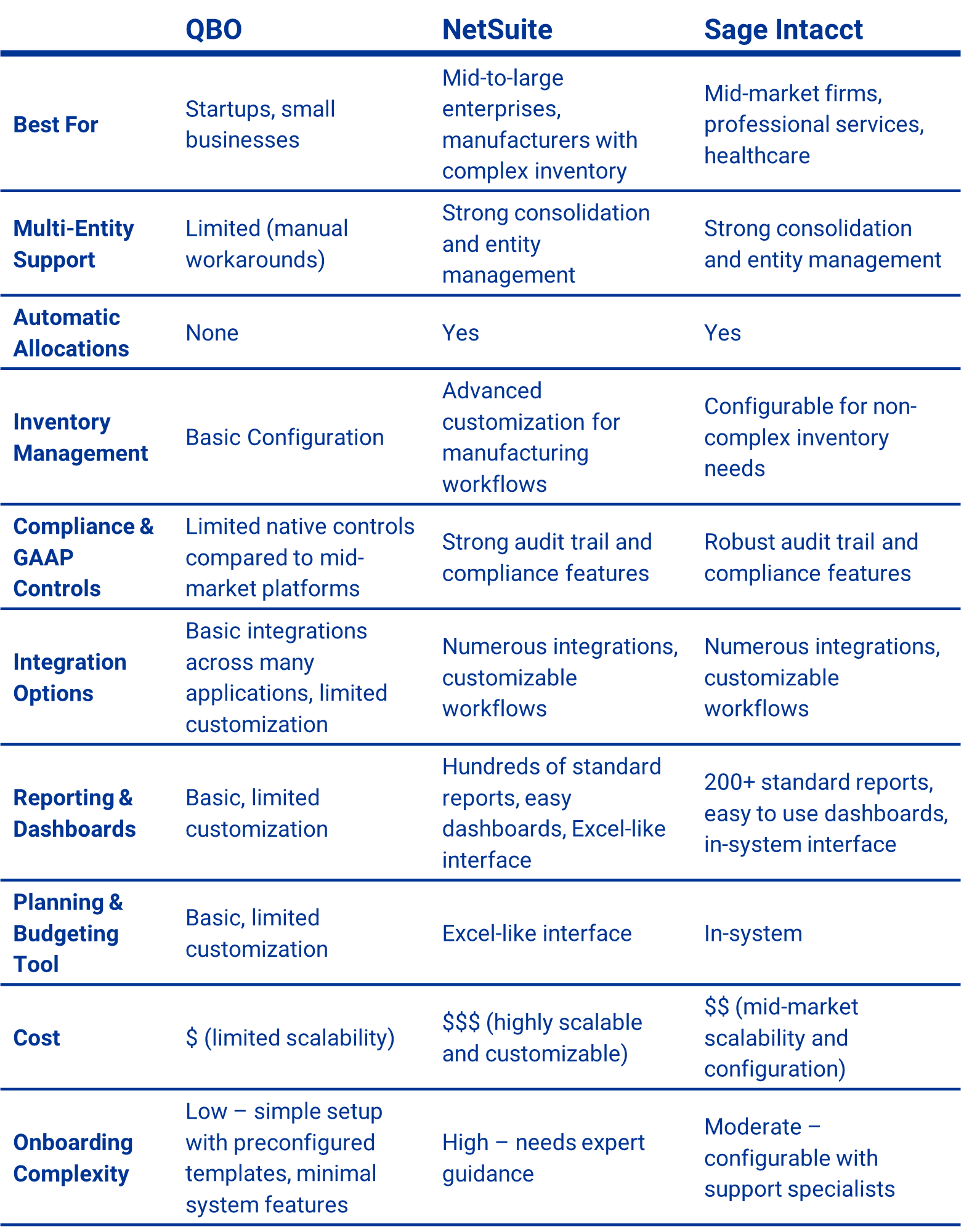
Each platform serves different goals. QuickBooks Online favors agility and simplicity. NetSuite prizes scale and customization. Sage Intacct balances configurability with accessibility. Selecting an ill-fitting choice can leave your business either overbuilt or underpowered, both of which are expensive misalignments.
Outgrown accounting systems create challenges for businesses every day. The following two scenarios, drawn from common industry experiences, show how the wrong platform can stall growth and why the right upgrade makes all the difference:
A U.S.-based manufacturer started with QuickBooks Online, which worked fine in the early years. However, as inventory complexity grew (e.g., multiple warehouses, varied SKUs, layered pricing structures), month-end close became a tangle of manual adjustments for stock transfers, backorders, and cost allocations. Spreadsheets filled the gaps that the software couldn’t handle, creating delays, errors, and audit risk.
The Upgrade: Transitioning to NetSuite changed the game. Real-time inventory tracking significantly reduced manual stock reconciliations and helped reduce errors. Automated allocations applied instantly, removing hours of manual data entry. Integrated forecasting provided visibility into demand and supply, enabling forward-looking decisions—all within a single system.
A mid-market professional services firm faced its first audit with financial data scattered across disconnected structures: billing in one platform, payroll in another, and project costs tracked in spreadsheets. Month-end close required hours of manual consolidations, increasing the likelihood of errors and incomplete audit trails. GAAP compliance and audit readiness felt out of reach.
The Upgrade: By moving to Sage Intacct, the firm gained automated multi-entity consolidations, built-in audit trails, and real-time dashboards for project profitability. Forecasting and planning shifted from reactive processes to proactive, system-driven insights, better positioning the firm for scalable growth.
Recognizing the signs and selecting the right platform is only half the battle, executing that change effectively requires skilled guidance. Successful implementations rely on experienced accounting and financial professionals who bridge the gap during periods of growth and transition.
These advisors align technology with business goals, supporting smooth onboarding, strengthening compliance readiness, and helping drive long-term return on investment (ROI). Their direction transforms what could be a disruptive move into a strategic lever.
Without this guidance, upgrades risk becoming cost-consuming, labor-intensive projects with disappointing results. Companies that delay transformation often face sharper corrections later, as inefficiencies compound and corrections become more urgent.
The cure for stagnation lies in renewal. For finance leaders, that means selecting the right accounting software that grows with the business and strategically shapes future performance, while leveraging the right support to make that vision a reality.
At Elliott Davis, we help companies evaluate, implement, and optimize financial systems that scale with custom dashboards and real-time metrics. Our advisors offer strategic insight to guide your next platform decision, so you can strengthen performance, improve compliance, and activate growth.
Ready to future-proof your financial operations? Contact us today to discuss your next steps.
The information provided in this communication is of a general nature and should not be considered professional advice. You should not act upon the information provided without obtaining specific professional advice. The information above is subject to change.
related
insights