Every industry has its own nuances. We take that into consideration and approach business solutions with the specific lens required of your field. Our teams are comprised of talent with relevant experience and we’re prepared to meet every challenge.
What if the story you tell yourself about your life is shaping who you become?
FSG Quarterly Financial Services Update - Q3 2026
Stay current on the latest FASB, SEC, FDIC, OCC, and Federal Reserve developments affecting financial institutions.
Replay: Financial Services Group Quarterly Accounting and Reporting Update
In this replay of our recent webinar, our team explores the accounting, regulatory, and industry developments affecting financial institutions today.
Busy or Effective?
Being busy can feel like progress, but activity doesn't always create meaningful results.
Workforce Development: Addressing physician burnout through a holistic operating model
Physician burnout affects care quality, retention, workforce stability, and financial performance. Learn how a three-part strategy can support physician well-being.
Every industry has its own nuances. We take that into consideration and approach business solutions with the specific lens required of your field. Our teams are comprised of talent with relevant experience and we’re prepared to meet every challenge.
Edit: Originally published on August 28, 2023. Updated to reflect current internal controls best practices.
Processes define how internal control activities are performed day to day. They determine how transactions are initiated, reviewed, approved, and recorded, and how information moves across systems and teams. When processes are unclear, overly manual, or fragmented across functions, organizations introduce avoidable risk, increase duplication, and slow execution.
When designed thoughtfully, processes create consistency, reduce inefficiency, and help teams execute with fewer handoffs and less rework. This creates a more efficient operating model where control activities are performed as part of the process, not as separate or reactive steps.
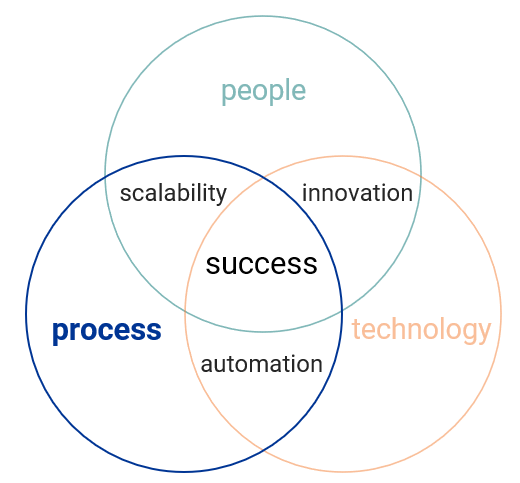
A company with good processes in place, structured to support its people and technology, holds the best recipe for success. However, establishing and maintaining those processes requires active management. As businesses grow, add systems, or expand responsibilities, control activities can become layered, duplicative, or inconsistent. Without regular evaluation, these inefficiencies increase both operational cost and control risk.
Is Technology Really the Problem, or Is It the Process?
Organizations often look to technology when performance breaks down. In practice, many issues stem from how processes are designed and executed, not the systems themselves.
When control processes are unclear or disconnected:
Teams rely on manual workarounds to complete activities
The same control steps are repeated across teams
Data must be reconciled across multiple sources
Ownership gaps lead to delays, errors, or missed reviews
In these cases, adding new technology can make things more complicated rather than resolve the issue. Without clear, integrated processes, automation can reinforce inefficiencies instead of removing them.
When processes are aligned, technology can support control execution more effectively by:
Reducing manual data entry and reconciliation
Standardizing approvals and review checkpoints
Improving visibility into control status and exceptions
How Process Design Improves Efficiency and Control Execution
Inefficient processes carry a measurable cost. Manual steps, duplicate activities, and inconsistent workflows increase the likelihood of errors and delay decision-making.
Process improvement through an internal controls lens focuses on:
Reducing manual effort by eliminating unnecessary steps and embedding automated or preventive controls
Eliminating duplication across teams, systems, and reporting activities
Integrating workflows so control activities occur once, at the right point in the process
Standardizing execution to improve consistency, documentation, and auditability
When control activities are integrated into the process, organizations spend less time verifying work after the fact and more time executing.
How to Evaluate the Effectiveness of Your Business Processes
Effective processes support performance and move the organization forward without unnecessary friction. Strong organizations regularly assess whether processes are enabling execution or introducing risk across key control activities. Best practices include:
Establishing shared understanding and accountability. Teams should know where each process begins, how it flows, and how responsibilities are divided, including appropriate checks, balances, and segregation of duties.
Connecting roles to outcomes. Help employees understand not just what they do, but why it matters and how their work affects performance, risk, and results across the organization.
Reassessing processes as the business changes. Revisit workflows regularly to confirm they still reflect how the business operates today and adjust as the organization evolves.
Simplifying and standardizing where it adds value. Processes should be clear, linear, and consistent across teams to improve efficiency, support cross-training, and reduce unnecessary variation.
Documenting processes and enhancing with technology. Clearly document processes and define how technology supports execution, visibility, and control.
Poorly defined processes can undermine even the strongest talent and most advanced technology. With focused observation and targeted adjustments, organizations can often identify practical improvements that strengthen execution and deliver more consistent results.
Frequently Asked Questions
What is a business process? A business process is a repeatable set of activities designed to achieve a specific objective. Examples include order fulfillment, month-end close, onboarding, or billing. Effective processes define who does what, when, and how work flows from start to finish.
How do processes differ from internal controls? Processes describe how work is performed. Internal controls are embedded within those processes to help manage risk, support accuracy, and promote accountability. Strong controls rely on clearly defined processes to function properly.
How often should business processes be reviewed? Processes should be reviewed regularly and whenever the organization experiences change, such as growth, system implementations, restructuring, or shifts in strategy. Annual reviews are common, but high-risk or high-volume processes may require more frequent evaluation.
Can better processes improve employee experience? Yes. Clear processes reduce confusion, rework, and frustration. When expectations and responsibilities are defined, employees spend less time navigating uncertainty and more time focused on meaningful work.
Is new technology required to fix broken processes? Not always. Many organizations find meaningful improvement by clarifying and standardizing existing workflows before investing in new systems. Technology is most effective when it supports well-designed processes.
We Can Help
Clear processes often make the difference between teams that operate in silos and those that work with alignment and purpose. Elliott Davis helps organizations assess, refine, and document processes so they support people, technology, and performance objectives.
Our team helps customers:
Evaluate process design across key workflows to identify gaps in approvals, reviews, and control integration
Identify manual activities, duplicate steps, and inefficiencies that increase operational cost and control risk
Assess how processes flow across teams and systems to reduce fragmentation and improve data consistency
Define ownership, decision points, and control responsibilities to strengthen execution and accountability
Align processes, controls, and reporting to support audit readiness, scalability, and evolving risk requirements
Contact us to learn more or explore other articles in this series:
The information provided in this communication is of a general nature and should not be considered professional advice. You should not act upon the information provided without obtaining specific professional advice. The information above is subject to change.
contact our team
No items found.
contact our team
contact our team.
related
insights
Improve Organizational Performance through People, Process and Technology
Learn how aligning people, processes, and technology can improve organizational performance—often by making better use of systems you already have in place.
Article
August 8, 2023
Improve Organizational Performance: Focus on Technology – The automation enabler
Learn how technology can speed up your processes and allow for a faster pace work environment. Consider which variables to prioritize when selecting technology.
Article
September 6, 2023
Improve Organizational Performance: Focus on People - Having the right people, with the right skills, in the right place
Learn how people are your greatest asset and largest expense in business, and how to hire and retain them for long-term success.