find your solution.
search for solutions by category, industries, insights, and people.

search for solutions by category, industries, insights, and people.
search for solutions by category, industries, insights, and people.
.jpg)

For construction contractors pursuing U.S. Department of Defense (DoD) work, cybersecurity has become a direct factor in bid viability. Beyond traditional safety, bonding, and performance requirements, the DoD now expects contractors to demonstrate verified cybersecurity controls as a condition of contract award.
That expectation is formalized through the Cybersecurity Maturity Model Certification (CMMC) program, which embeds cybersecurity directly into DoD contracts for companies that design, build, repair, or maintain defense facilities and infrastructure. Rather than relying on policy statements or self attestations, the program ties validated security practices to eligibility for both prime and subcontract work.
With phased implementation already underway, CMMC is rolling into new and existing contracts. For construction contractors, cybersecurity readiness now influences bidding strategy, teaming arrangements, and continued participation in the defense construction market.
For a broader overview of CMMC requirements and certification levels, see Understanding CMMC: What Defense Contractors Need to Know.
CMMC applies to both prime contractors and subcontractors across the Defense Industrial Base (DIB), including construction firms. Even when cybersecurity is not a contractor’s core business, construction projects often involve access to Federal Contract Information (FCI) or Controlled Unclassified Information (CUI).
Examples include:
When this information resides on contractor-managed systems or third-party platforms, CMMC requirements apply.
CMMC is a DoD-mandated cybersecurity assessment and certification program that verifies whether contractors have implemented required safeguards for FCI and CUI. Unlike prior models that relied largely on contractor representations, CMMC ties verified cybersecurity practices directly to contract eligibility.
The framework aligns existing requirements into a single enforceable standard across the defense supply chain.
Most DoD construction contractors will encounter either Level 1 or Level 2 requirements.
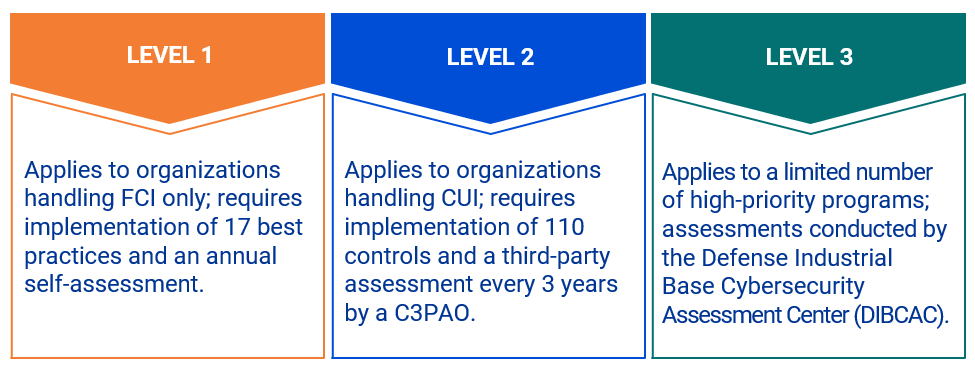
CMMC requirements are now being incorporated into DoD contracts and have become a condition of contract award. Failure to meet the required CMMC level can result in loss of eligibility to bid or participate in defense contracts, including as a subcontractor.
Phased implementation is now underway. CMMC requirements are now appearing in solicitations and contracts, marking the transition from policy guidance to active enforcement.
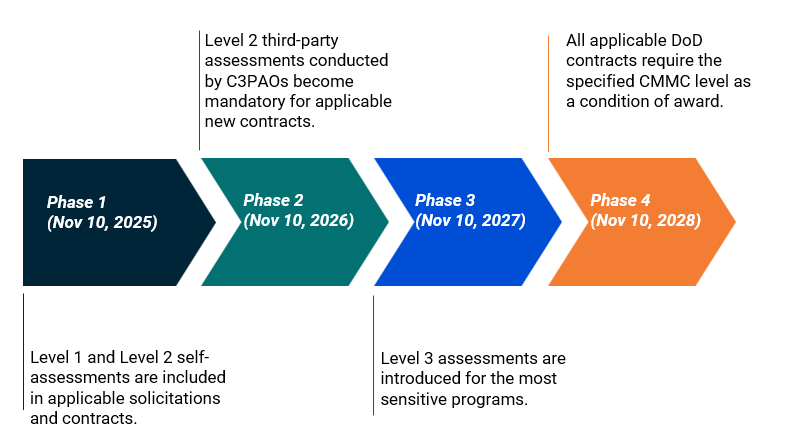
For construction contractors, these milestones often overlaps with long bid and award cycles, multi year project timelines, and layered subcontractor relationships. As a result, CMMC compliance affects not only IT systems, but also project planning, teaming strategies, and risk management decisions across the life of a contract.
CMMC readiness helps construction firms understand how cybersecurity requirements apply to their operations before certification becomes mandatory.
At Elliott Davis, a CMMC Readiness Assessment is performed by a coordinated team that understands construction operations, project workflows, and DoD expectations. Readiness efforts focus on:
For construction contractors, readiness often clarifies where cybersecurity responsibilities sit across field operations, corporate systems, and third party platforms.
CMMC reflects a broader shift in how the DoD manages risk across its supply chain. Cybersecurity is now treated as a prerequisite for participation, not an administrative afterthought.
Construction contractors that address readiness early are better positioned to respond to solicitations, support prime contractor requirements, and maintain continuity across active and future projects.
Elliott Davis works with construction contractors in the DoD pipeline to support CMMC readiness through scoping, gap assessments, and planning support. Our focus is helping firms understand how CMMC applies to their operations and what steps support contract access as requirements continue to roll into DoD construction work.
Contact us today to start the conversation.
The information provided in this communication is of a general nature and should not be considered professional advice. You should not act upon the information provided without obtaining specific professional advice. The information above is subject to change.


.avif)

.jpg)

