find your solution.
search for solutions by category, industries, insights, and people.


find your solution.
search for solutions by category, industries, insights, and people.
search for solutions by category, industries, insights, and people.
search for solutions by category, industries, insights, and people.
.jpg)

Cybersecurity is now a contractual requirement for companies doing business with the U.S. Department of Defense (DoD). Across the Defense Industrial Base (DIB), the Cybersecurity Maturity Model Certification (CMMC) program is the DoD’s mechanism for verifying that contractors and subcontractors adequately protect sensitive defense information within their systems. For organizations pursuing or maintaining DoD contracts, demonstrating baseline cybersecurity controls is no longer optional.
With the final rule published and phased implementation underway, CMMC requirements are being incorporated directly into contracts. Organizations that handle Federal Contract Information (FCI) or Controlled Unclassified Information (CUI) must understand what CMMC requires, how it affects contract eligibility, and how early readiness, supported by an experienced assessment team, fits into the broader compliance picture.
CMMC is a DoD mandated cybersecurity assessment and certification program designed to verify that defense contractors implement required safeguards for FCI and CUI on non federal information systems. Unlike prior frameworks that relied largely on contractor self attestation, CMMC introduces formal assessments tied directly to contract award and continuation.
Oversight of the CMMC ecosystem is handled by the Cyber AB, which accredits CMMC Third-Party Assessor Organizations (C3PAOs) and maintains the CMMC Marketplace under an exclusive contract with the DoD. Together, these elements consolidate existing DoD cybersecurity requirements into a single, enforceable framework applied consistently across the defense supply chain.
Note: ISACA is now the Cybersecurity Assessor and Instructor Certification Organization (CAICO) as of April 1, 2026.
Any entity handling DoD contract data is subject to CMMC requirements, including prime contractors, subcontractors, suppliers, and vendors. Since requirements flow down the defense supply chain, even small or indirect participants may need CMMC certification to remain eligible for DoD work.
For organizations handling CUI, this means pursuing a Level 2 certification, which involves a formal third-party assessment.
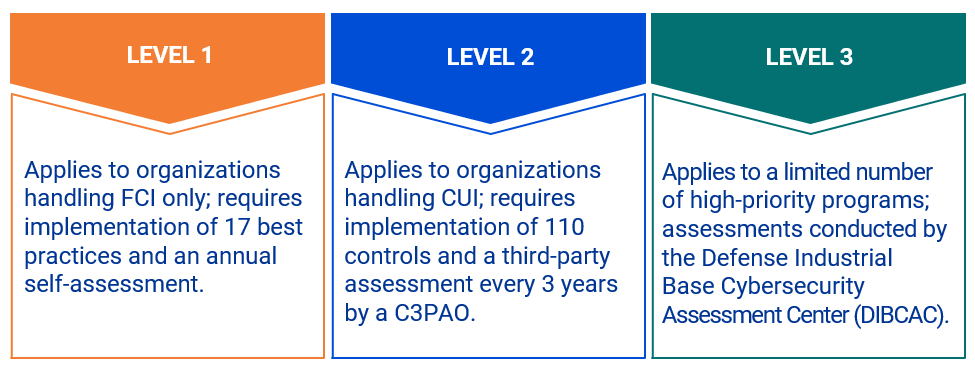
CMMC 2.0 simplifies the original model into three certification levels:
The DoD estimates that over 80,000 entities will be required to meet CMMC Level 2 requirements to remain eligible for defense contracts. For these organizations, engaging a qualified team to perform a CMMC Readiness Assessment is often critical to identifying gaps and reducing assessment risk before interacting with a C3PAO.
As CMMC continues to roll into new and existing DoD contracts, failure to meet the required certification level can result in loss of eligibility for defense work.
The DoD finalized the CMMC rule in October 2024, and phased implementation is now underway. As of November 10, 2025, CMMC requirements began appearing in solicitations and contracts, marking the transition from policy to enforcement across the defense supply chain.
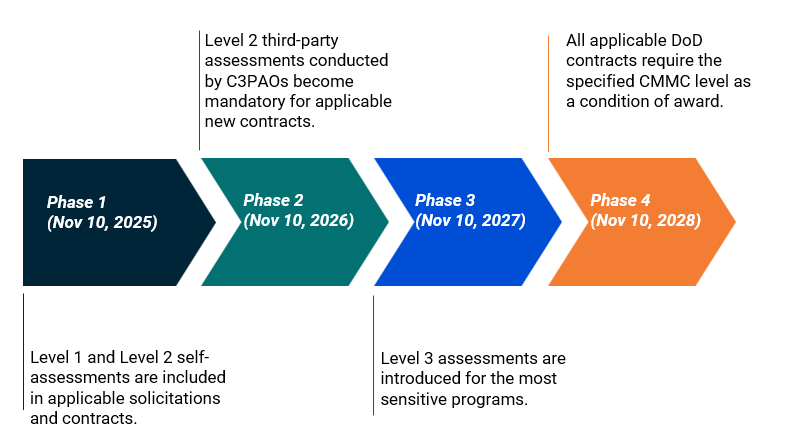
For defense contractors, non compliance carries tangible consequences, including ineligibility for contract award, loss of option years, and flow down challenges with prime contractors and subcontractors. As a result, CMMC is already influencing near-term contract access and bidding decisions.
A CMMC readiness assessment evaluates both the implementation and documentation of applicable CMMC requirements while preparing the organization for a future formal assessment.
Readiness activities typically include the following steps:
These efforts reduce assessment risk and support informed decision making, while remaining independent from the formal certification process conducted by authorized assessors.
CMMC represents a more rigorous approach to how the DoD enforces cybersecurity across the defense supply chain. While many underlying controls are familiar, verification, accountability, and contractual consequences are new.
Organizations that invest early in CMMC readiness gain clearer visibility into scope, cost, and timing, positioning them to compete for and retain defense work as requirements enter contracts.
Elliott Davis supports defense contractors through CMMC readiness services focused on education, assessment, and planning. Our work helps organizations understand where they stand, what gaps exist, and how to move forward with confidence as CMMC requirements continue to take effect.
Contact us today to start the conversation.
The information provided in this communication is of a general nature and should not be considered professional advice. You should not act upon the information provided without obtaining specific professional advice. The information above is subject to change.
.jpg)

.jpg)
%20(1).jpg)


